
18 Jun 2026
Highlights from EHA 2026
What is the European Haematology Association (EHA) Congress?
This year more than 14,000 researchers, clinicians, patient advocates and industry leaders gathered in Stockholm for the 2026 European Haematology Association (EHA) Congress. Although based in the EU this meeting brings global haematology experts together to discuss some of the biggest advances and ongoing work in the field. With sessions ranging from ‘red cells and iron’ to ‘Von Willenbrand Disease’ it encompasses most of the haematology field. 
One of the highlights of EHA 2026 was seeing the impact of researchers supported by Leukaemia UK both past and present. Across oral presentations, posters, scientific committees and leadership roles, our research community was well represented.
Congratulations go to Dr Miguel Ganuza, who was awarded a prestigious grant prize during the congress, recognising the importance and potential impact of his work.
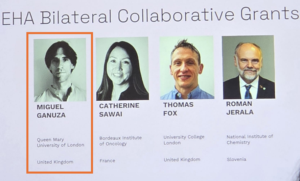
EHA Bilateral Collaborative Grant winners – highlighting Dr Miguel Ganuza.
We were also delighted to see presentations and contributions from researchers including Dr Simon Richardson, Dr Cecile Lopez, Dr Giulia Orlando, members of Dr Sophie Kellaway‘s research team, and Prof. Vignir Helgason, all of whom continue to advance understanding of leukaemia biology and treatment.
The meeting also brought recognition for UK leadership within the global haematology community. Prof. Brian Huntly was named President-Elect of the European Haematology Association, an outstanding achievement that reflects his significant contributions to the field.
Many other researchers connected to the Leukaemia UK community were actively involved throughout the congress, including Dr Maria Teresa Esposito, Dr Simona Valletta, and Dr Gillian Horne and her team, who contributed through scientific committees, presentations and poster sessions.
Their presence throughout EHA 2026 highlights the strength of leukaemia research taking place across the UK and reinforces the importance of continued investment in innovative science.
Putting Patients at the Centre of Progress
A major theme running throughout the congress was the growing role of patients in shaping research, healthcare policy and access to treatment.
Discussions involving patient organisations, regulators, healthcare professionals and industry representatives highlighted how patient-reported outcomes (PROs) are becoming increasingly important in clinical trials. Researchers and decision-makers are recognising that treatment success cannot be measured by survival alone. Quality of life, treatment burden, fatigue, emotional wellbeing and the impact of treatment on daily living all matter to patients and should be reflected in how new therapies are evaluated.
At advocacy sessions involving organisations such as the Acute Leukaemia Advocates Network (ALAN), discussions focused on strengthening patient education, improving access to medicines and ensuring patient representatives are recognised as meaningful partners in healthcare decision-making.
The message was clear: patients should be involved throughout the entire pathway, from research design and clinical trials through to regulatory approval, reimbursement and access decisions.
The Growing Importance of MRD
A strong scientific theme across EHA 2026 was the increasing importance of measurable residual disease (MRD).
MRD refers to the small number of leukaemia cells that may remain after treatment and can often predict relapse before it becomes clinically apparent. Multiple studies demonstrated the growing role of molecular MRD monitoring in AML and other leukaemia’s.
Researchers compared blood and bone marrow testing approaches, explored the use of next-generation sequencing technologies and discussed new molecular markers that may improve monitoring in the future, including NPM1, IDH1 and IDH2 mutations. Researchers from all over the globe presented what strategies are used in their hospitals and what the benefits are.
The field is increasingly moving towards using MRD not only as a prognostic tool but potentially as a guide for treatment decisions. Questions explored during the congress included whether treatment duration could eventually be tailored according to MRD response and whether deep MRD negativity could help identify patients who may safely stop treatment.
Acute Leukaemia
Acute myeloid leukaemia (AML) remains one of the fastest-moving areas of blood cancer research. Educational sessions highlighted just how much the treatment landscape has changed over the last decade, with approximately fourteen new therapies approved since 2014. There were dedicated clinician sessions which spoke about how to tailor treatment and discussions on how long to keep patients on certain treatments, using case studies as examples.
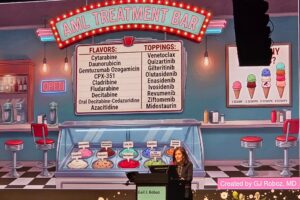
Image showing an analogy of the different types of treatment options for AML – displayed as ice cream flavours with other treatment options as toppings.
The era of treating AML as a single disease is rapidly coming to an end. Researchers increasingly recognise AML as a collection of genetically distinct diseases, each potentially requiring different treatment approaches.
Several sessions explored the transformative impact of venetoclax-based combinations, particularly for older adults and patients who may not be suitable for more intensive treatment approaches. However, researchers also highlighted the ongoing challenge of treating patients whose disease relapses following venetoclax therapy, emphasising the need for new treatment strategies.
One of the most exciting areas of AML research continues to be the development of Menin inhibitors. These therapies have shown particular promise in patients with NPM1-mutated AML and KMT2A-rearranged leukaemia, two genetically defined groups that appear highly sensitive to Menin inhibition. New data presented at EHA 2026 demonstrated impressive remission rates and high levels of MRD negativity, reinforcing optimism that Menin inhibitors could become an important new treatment option in the coming years.
Researchers also presented new work investigating mechanisms of resistance to Menin inhibitors, helping to identify future combination strategies that may further improve outcomes.
Advances in CLL and CML
Important progress was also reported in chronic lymphocytic leukaemia (CLL) research and treatment.
One of many significant presentations came from the Phase 3 BRUIN CLL-322 trial, which evaluated the addition of pirtobrutinib to venetoclax and rituximab (a BTK inhibitor, BCL-2 inhibitor and an anti-CD20 monoclonal antibody respectively) in patients with relapsed or refractory CLL or small lymphocytic lymphoma (SLL).
The study demonstrated a 45% reduction in the risk of disease progression or death compared with venetoclax and rituximab alone. Importantly, around 80% of participants had previously received a covalent BTK inhibitor, reflecting real-world treatment patterns. The safety profile remained consistent with previous studies and did not result in meaningful increases in treatment discontinuation.
Notably, this is the first Phase 3 CLL study to demonstrate superiority over a venetoclax-containing control arm, representing an important milestone for the field.
In chronic myeloid leukaemia (CML), the focus has increasingly shifted from survival to survivorship. More than twenty-five years after the introduction of imatinib transformed outcomes for patients, discussions now centre on treatment burden, quality of life and treatment-free remission (TFR).
Fatigue remains one of the most significant challenges facing patients, while treatment intolerance continues to be a major reason for switching therapies. Researchers highlighted growing evidence that achieving a deep molecular response early in treatment is one of the strongest predictors of successful treatment discontinuation later on.
There was also considerable interest in newer therapies such as asciminib, which may offer improved tolerability and help more patients achieve the long-term treatment responses needed for treatment-free remission.
Looking Ahead
EHA 2026 demonstrated that leukaemia research continues to advance at an extraordinary pace. Precision medicine approaches are becoming increasingly sophisticated, MRD is moving closer to routine clinical decision-making, and new targeted therapies are offering hope to patients with difficult-to-treat disease.
At the same time, the congress reinforced that progress is about more than scientific breakthroughs alone. Improving quality of life, reducing treatment burden, increasing access to innovative therapies and ensuring that patients have a meaningful voice in decision-making are all essential components of improving outcomes.
It was inspiring to see how truly global this European meeting was, with participants from China, Australia, the United States, and many other countries. The haematology community is remarkably collaborative and dedicated, as demonstrated by meetings such as the EHA. For Leukaemia UK, it was encouraging to see so many researchers connected to the organisation presenting and contributing to the programme. This reinforces our confidence that we are investing in the right people and projects, ensuring that every supporter donation helps fund cutting-edge research. Their work is driving the next generation of discoveries and bringing us closer to a future where more people survive leukaemia and live well beyond their diagnosis.
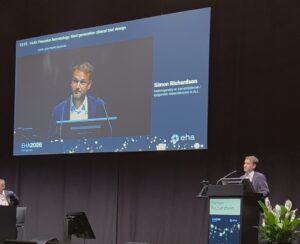 Dr Simon Richardson |
 Dr Cecile Lopez |
 Dr Giulia Orlando |
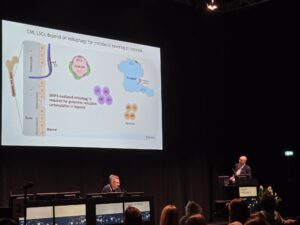 Prof. Vignir Helgason |
Discover our research blogs.
Related posts
15 February 2024
Vogue model who survived leukaemia as a child joins Leukaemia UK in calling for more donations for research to stop blood cancer ‘destroying childhoods’
Vogue model Saffron Vadher has joined Leukaemia UK on International Childhood Cancer Day (February 15th) in calling for more research into the blood cancer. Leukaemia is the most common type…
5 December 2022
John Goldman Fellowships for 2023 now open
Leukaemia UK is delighted to announce that we are funding more ground-breaking research in 2023, by continuing our investment in early career scientists and clinicians for our prestigious John Goldman…
17 October 2023
Leukaemia UK announces four pioneering projects into one of the deadliest forms of cancer
Applications for the 2024 John Goldman Fellowships will open on 01 December 2023. The deadline for applications is 12 noon on 31 January 2024. Find out more and apply. Leukaemia UK…
1 August 2022
Pedalling pair’s crazy peaks challenge to stop leukaemia cutting short the lives of beloved mums
Leukaemia UK supporter, Alistair, who lost is mum to leukaemia less than a year ago, is setting out on an extreme fundraising challenge. Alistair, who is from Lincoln, and his…