

18 Dec 2025
Research blog: Key Highlights from ASH 2025
How gentler, smarter and more personalised therapies are reshaping the future of treatment and care.
The American Society of Haematology (ASH) Annual Meeting is the biggest global gathering in blood cancer research. With many thousands of researchers and clinicians attending, plus people from pharma companies and patient organisations, the meeting offered a first look at new scientific developments, emerging treatments, and results from clinical trials that could shape the future of leukaemia treatment and care.
Across many presentations, a clear theme emerged: treatments are becoming more targeted and less toxic. The shift away from traditional intensive chemotherapy, the rise of precision-targeted drugs and the rapid development of immunotherapies are collectively transforming how leukaemia is understood and treated.
A shift toward gentler, more targeted therapy
For decades, many people with acute leukaemias have relied on intensive chemotherapy regimens. While effective for some, these treatments can be extremely harsh on the body. This year’s ASH meeting reinforced that the future lies in kinder but smarter treatments, led by tailoring treatment to genetic sub-types. One of the clearest examples is the growing use of the combination of azacitidine and venetoclax for acute myeloid leukaemia (AML). These drugs work by disrupting cancer cells’ survival pathways and are showing impressive results in some patients with far less toxicity than intensive chemotherapy. Many studies presented at ASH confirmed that this approach not only improves survival outcomes but can also offer patients a better quality of life.
Alongside this shift, researchers continue to explore how targeted therapies can be used earlier in treatment, in combination with standard therapies or as an alternative to chemotherapy altogether.
Acute myeloid leukaemia (AML)
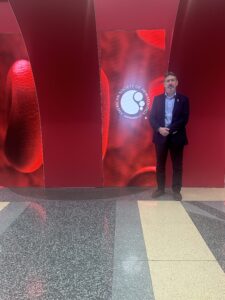
Dr Simon Ridley, Director of Research and Advocacy representing Leukaemia UK at the 2025 ASH conference
In terms of leukaemia, AML remained one of the most active areas of research at ASH 2025. Many presentations highlighted just how much progress is being made in finding safer, more effective ways to treat this complex disease.
One of the most promising developments, presented by Dr Johanna Rausch (i), is the rise of menin inhibitors, a new class of a targeted drug that disrupts a protein which some AML cells depend on for growth. Drugs such as revumenib and ziftomenib are showing encouraging results, particularly in AML with NPM1 mutations or KMT2A rearrangements – two genetic changes that often make the disease more aggressive. Early data presented at the meeting showed that some patients achieved very deep remissions, including cases where no cancer cells could be detected using highly sensitive tests.
The study also explored the synergistic effect of menin inhibitors combined with cutting-edge CAR-T cell therapy to boost effectiveness. CAR-T cells are immune cells that have been genetically engineered to recognise and destroy cancer. When used alone in AML, CAR-T has faced challenges because AML cells can hide from the immune system. But researchers showed that treating AML cells with a menin inhibitor first made them more visible to CAR-T cells by increasing levels of a surface marker called CLEC12A. The combination had a powerful effect in laboratory and animal studies, raising the possibility of future clinical trials designed around this dual approach.
Stem cell transplant research was also an important theme. The Leukaemia UK co-funded UK IMPACT clinical trials network presented new data by Prof. Charles Craddock (ii) on how to improve the safety and success of transplants. As transplant remains the only curative option for many AML patients, this research is vital.
Acute lymphoblastic leukaemia (ALL)
There was major progress reported in both childhood and adult ALL. CAR-T therapy continues to transform outcomes for people whose disease has returned after standard treatment. Teams from across the world, including Great Ormond Street Hospital (GOSH), shared important updates showing that refined CAR-T designs and treatment protocols are improving remission rates and long-term outcomes (iii).
One of the most exciting advances came in T-cell ALL, a subtype that has historically been extremely hard to treat with CAR-T because engineered T-cells tend to attack each other. This year, researchers from GOSH / University College London presented success using gene-edited immune cells designed to avoid this problem. Although the results come from a very small group of patients, they represent an important progress in a potential cure to T-ALL.
Chronic lymphocytic leukaemia (CLL)
CLL research at ASH 2025 focused on optimising therapy and giving patients more choices. New data on targeted drugs like acalabrutinib (Calquence) continued to support their long-term effectiveness. Researchers are exploring how best to combine or sequence these therapies to tailor treatment better.
A major question in CLL treatment has been whether therapy should be continuous or time-limited. The CLL17 study provided clear evidence that fixed-duration therapy – where treatment is given for a defined period and then stopped – can work just as well as continuous therapy, but with fewer long-term side effects. For many patients, this offers the appealing possibility of remission without needing to remain on treatment indefinitely.
Chronic myeloid leukaemia (CML)
In CML, several talks highlighted a growing pipeline of next-generation targeted drugs known as tyrosine kinase inhibitors (TKIs). These newer TKIs aim to offer options for patients who develop resistance or intolerance to existing treatments. While still at an early stage, some of the initial data presented at ASH were encouraging. The coming years will reveal whether these drugs will eventually become available to patients in the UK.
Myeloproliferative neoplasms (MPNs)
A promising theme this year was the emerging role of menin inhibitors in diseases beyond AML. Dr John D. Crispino presented early results showing that revumenib, already being studied extensively in AML, may also have potential in treating certain MPNs – conditions where the bone marrow makes too many blood cells.
What made this research particularly striking was evidence that revumenib not only reduced high white blood cell and platelet levels, but also appeared to reverse bone marrow fibrosis (scarring) when used alongside the existing drug ruxolitinib. If future trials confirm this, menin inhibition could become a genuinely disease-modifying strategy for some MPNs, rather than simply a way of controlling symptoms.
Multiple Myeloma (MM)
Another highlight of this year’s ASH conference was seeing research supported by Leukaemia UK showcased on the global stage, highlighting the real impact of our funding. One example was work co-led by former John Goldman Fellow, Prof. Simon Mitchell (iv), which explored how the genetic complexity of multiple myeloma makes predicting disease course challenging. By combining detailed genomic and clinical trial data with computational modelling, the team created patient-specific “virtual” cells that predicted whether cancer cells were more likely to survive, proliferate or undergo cell death, and showed these patterns were linked to patient outcomes. This kind of precision modelling has clear relevance for leukaemia, where similar genetic diversity drives disease behaviour and could help improve risk stratification and treatment decisions.
Many presentations at ASH went beyond treatment to explore the root causes of how leukaemia develops. Professor Adam Mead from the University of Oxford delivered an especially compelling talk on new insights into blood cell formation, including work supported by Leukaemia UK through Dr Giulia Orlando’s John Goldman Fellowship. This research helps reveal the earliest steps in how healthy blood stem cells can acquire mutations, become dysregulated and eventually transform into leukaemia. Understanding these early processes is critical for developing preventative strategies and earlier interventions in the future.
Looking Ahead
Across all types of leukaemia, it was clear from ASH 2025 that new kinder, more effective treatment possibilities are evolving rapidly. We are entering an era defined by smarter combinations, targeted medicines, personalised treatment plans and increasingly powerful immunotherapies. Clinical trials over the next few years will be crucial in determining how soon these innovations become part of everyday treatment and care, but the momentum is undeniably positive.
Discover our research blogs.
References:
(i) https://oncodaily.com/voices/michael-kuhn-425216 Accessed 11/12/2025
(ii) https://meetings-api.hematology.org/api/abstract/vmpreview/291149 Accessed 10/12/2025
(iii) https://ashpublications.org/bloodadvances/article/9/4/913/534813/CAR-T-cell-therapies-for-T-cell-malignancies-does Accessed 10/12/2025
(iv) https://ashpublications.org/blood/article/146/Supplement%201/5790/555776/Applying-computational-modelling-to-a-high-risk Accessed 17/12/2025
Related posts
21 May 2020
A new clinical trial announced
A study into the impact of severe covid-19 infection on patients who receive stem cell transplants for blood cancers and blood disorders.
15 February 2024
Vogue model who survived leukaemia as a child joins Leukaemia UK in calling for more donations for research to stop blood cancer ‘destroying childhoods’
Vogue model Saffron Vadher has joined Leukaemia UK on International Childhood Cancer Day (February 15th) in calling for more research into the blood cancer. Leukaemia is the most common type…
31 October 2022
Leukaemia UK appoints new Director of Communications job share from Shelter to lead their ambitious strategy
Blood cancer research charity, Leukaemia UK, has hired Anna Wilson and Lizzie Afonso from housing and homelessness charity, Shelter, to job-share its new Communications Director role. This is the first…
7 November 2022
Leukaemia UK appoints Ian McCafferty CBE as their new Chair of Trustees to support new strategy to stop leukaemia devastating lives
Ian McCafferty CBE will take up the role in January 2023, from current Chair of Trustees, Chris Corbin OBE, and will lead the charity as it continues to grow. Chris…