
11 Jun 2019
Melvyn’s story
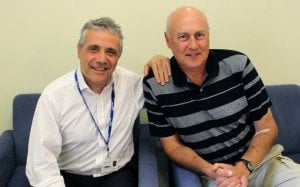
In 2012 Melvyn, a bone marrow transplant patient, suffering from an aggressive form of graft-versus-host-disease was given pioneering, life-saving treatment, Mesenchymal Stem Cell Therapy, at The Catherine Lewis Centre.
 “I was first diagnosed with leukaemia in July 1998 after complaining of fatigue to my local GP,” says Melvyn.
“I didn’t know what the disease was at the time but my wife Pauline took the news very badly as she understood what the outcome could be.
“I wanted to see my children graduate – my daughter was 13 and my son 15 – so I was determined to fight it and stay positive. It was a huge shock for my family.”
Melvyn successfully underwent a stem cell transplant just 10 weeks later, and although he responded well initially he started to experience a serious complication called graft-versus-host-disease (GvHD), where the newly transplanted cells attack the recipient’s body.
“I remember reaching out to turn the bedside lamp off and noticing for the first time hard lumps on my arms. By the time I went to clinic, it had spread all over my body from my neck to my ankles and my skin had become so thick that I found it hard to move.
“I saw the rheumatologist and started a new steroid drug regime, it worked well for around two years, but the risk of infection and relapse were so high that I stopped taking them.
“After a couple of years GvHD deteriorated; but thankfully, because of research funded by Leukaemia UK, I was given the opportunity to trial a new treatment called Mesenchymal Stem Cell Therapy, which has significantly improved my life.”
Professor Francesco Dazzi
“Leukaemia UK has enabled us to initiate this treatment and gather preliminary evidence with some extraordinary results. In Melvyn’s case, we isolated cells taken from his daughter, prepared them here at The Catherine Lewis Centre and, when they were ready, we infused them.
“We have seen a 50% improvement in Melvyn’s condition and I am thrilled that we have been able to improve both his outlook and quality of life.”
Related posts
29 November 2021
John Goldman Fellowship awarded to Dr Pramila Krishnamurthy
Leukaemia UK is proud to announce Dr Pramila Krishnamurthy of King’s College Hospital and King’s College London as a Leukaemia UK John Goldman Fellow co-funded by Rosetrees Trust. Dr Krishnamurthy will be using the fellowship to better understand why some leukaemia patients relapse following a stem cell transplant, and how donor lymphocyte infusion can help prevent this.
21 June 2023
Prestigious jointly-funded fellowship could be catalyst for myeloma prevention
Dr Louise Ainley, University College London, has been awarded a Clinical Research Training Fellowship – jointly funded with the Medical Research Council. The three-year project is set to investigate which…
25 November 2025
Improving access to life-changing treatment – Leukaemia UK’s role in the approval of Aucatzyl
Today, NICE announced its recommendation for Aucatzyl (obecabtagene autoleucel), a CAR-T therapy, to be made available on the NHS for treating adults aged 26 and over with relapsed or refractory…
19 December 2023
Beloved actor who beat leukaemia now fronting charity TV ad to help raise vital funds
83-year-old actor Richard Tate will appear on screens from 26th December onwards to support Leukaemia UK’s call for legacy pledges (otherwise known as gifts in Wills), after surviving leukaemia thanks…