
04 Dec 2025
“Hockey has been a huge part of my life and a huge factor in who I am”
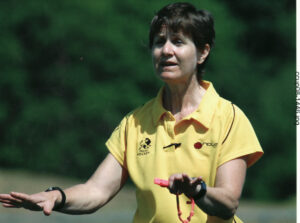
Sarah Chapman umpiring at the Hockey Outdoor Nationals
One of the biggest goals at the end of Sarah Chapman’s path through leukaemia treatment was to get back onto the hockey pitch as both a player and a National League umpire.
Coming from a sporty family, Sarah played ‘everything on offer’ at school and got serious about hockey in 1977 when she joined the Maidstone Hockey Club. She played up to first XI at the club and also at minor county level and is now one of her club’s Vice Presidents. In the 1980s she switched fully to umpiring, achieving a place on the national stage. She has made lifelong friends at the club and within the playing, umpiring and umpire coaching community. They are all part of her ‘hockey family’.
When, in 2011, Sarah, who was in her early 50s at the time, started to feel very tired, she initially blamed menopause. But her level of fitness and body awareness told her that something wasn’t quite right.
“I had been a regular blood donor, but my haemoglobin was constantly too low to be accepted,” said Sarah, 66, who lives in Kent and is a retired NHS audiologist. “My diet was good, and taking iron supplements didn’t make any difference. My endurance dropped, I got repeated illnesses and chest infections, and any wounds took a long time to heal. I also had night sweats and my skin was bad. As well as hockey I played tennis, went to the gym, hiked, skied and cycled. I was used to injuries and just bouncing back. I remember going on a walking holiday on the coast with my husband Mike and taking a few steps and just having to stop. It was such a strange feeling and a worry.”
Over the next two years Sarah made countless visits to her GP.
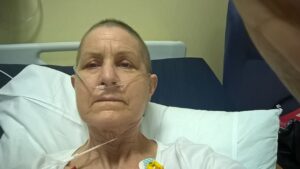
Sarah during treatment
“I was referred to many different specialists and told that it was probably due to my age as I was around menopause. But I knew what I was capable of, and how active I was, and I felt deep down something was wrong. They carried out many blood tests, although I wasn’t sure which markers were being looked for at the time, or whether they had a suspicion of a blood disorder. But I was told everything was normal.”
In 2012 and 2013 Sarah experienced chest pains following yet more chest infections and breathing difficulties, which were eventually diagnosed as pulmonary embolisms. With her own GP on holiday, she saw another at the same practice. He looked at all her blood results again and this time spotted an anomaly. Further tests were taken, which indicated a worrying trend in abnormal blood cell size, Sarah was referred to the haematology department at Maidstone Hospital.
“They diagnosed myelodysplastic syndrome (MDS) and told me this would become leukaemia within the next three to five years. I was put under the care of the MDS specialist team at Kings College Hospital. I was worried and didn’t like having it hanging over me. However, I was relieved that I had finally been vindicated in knowing my body well enough to keep insisting something was wrong.
“I had to have regular blood tests, and bone marrow biopsies both at Maidstone and in London which were awful. I kept working, continued to umpire hockey and keep up with all my other sport and activities as I wanted to be fit enough to endure future treatments. But of course, it was always at the back of my mind; every new symptom would make me wonder if this was ‘it’.”
In June 2016, Sarah was told the news she had been dreading – that she had developed acute myeloid leukaemia (AML).
“It was almost on the dot of three years – as they’d predicted. A bone marrow biopsy had showed my level of normal blood cells had plummeted. Oddly enough my symptoms hadn’t changed at all. I’d just packed to go to Madeira when the consultant rang and told me I needed to come to Maidstone Hospital. My stomach hit the floor but I said I was going on holiday the next day and could I attend when I returned? She said “no as we can’t guarantee you’ll come back”.
Sarah started three rounds of chemotherapy as an in-patient at Maidstone.
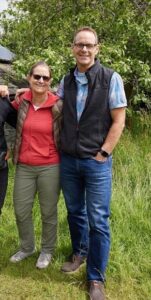
Sarah and her brother
“They cared for me so well. Each time I was an inpatient for two to three weeks, returning home for a week or so before the next treatment. Mike, who is also involved in the hockey club, was my fitness coach and kept me going! We would go for walks and gentle bike rides during those treatment rest periods. He was also a great mindset coach. I would concentrate on getting through each day and what I had to do next, and he did all the background research so I didn’t have to worry. My family and hockey friends were also amazing in putting together activity boxes to keep me occupied, and often just visiting in support.
“I was in isolation a lot of the time which I actually preferred to being on a multi-bedded ward. I found it good to structure my day with exercise, reading and crafting. My sister gave me some cards with bed exercise routines on them, and I got a little set of bike pedals that went on the floor in front of a chair.”
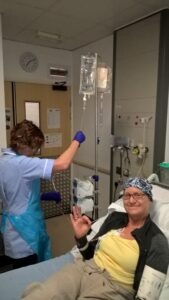
Sarah’s transplant nurse used to play for Doncaster Hockey Club
The third chemotherapy session saw Sarah in full remission, but she still opted to go ahead with a stem cell transplant to increase her chances of avoiding relapse for which, at the time, further treatment options were limited.
“They tested my three siblings; my younger brother Colin was a 10/10 match. In October 2016 I went to Kings Hospital for conditioning treatment. That was very hard with awful mucositis. My transplant was on 10th November 2016, and I was only there for three weeks in total before my neutrophils started to recover. Then I went home to continue my recovery.
“Mike was again amazing, making me start with a walk up and down the hallway, then to the end of the drive, and eventually around the block. I had plenty of naps in between, but it was great having these goals. My sons lived locally at that time and my parents too, so we had plenty of support.”
Sarah spent a year regaining her strength and in September 2017 made a grateful return to playing hockey and umpiring.
“It felt strange as I’d lost a deal of weight and strength, but my hockey family were so encouraging and supportive. I had the goal of being reassessed for the national umpire panel and achieved that in 2018.”
Sarah retired from her job in the NHS and now does a couple of days a month as an audiologist in a private clinic. Mike has retired as well, and the couple have enjoyed plenty of walking holidays, travel abroad, camping, and now new grandchildren.
“I’m now fully in remission and my medical team say I am considered cured. I’m advised that my chances of relapse are now no different from other people. Treatment options are being discovered all the time, so I’m confident that I would stand a good chance of being cured again if I ever relapse.
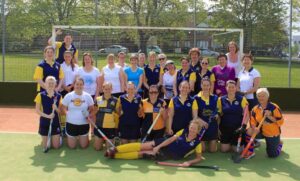
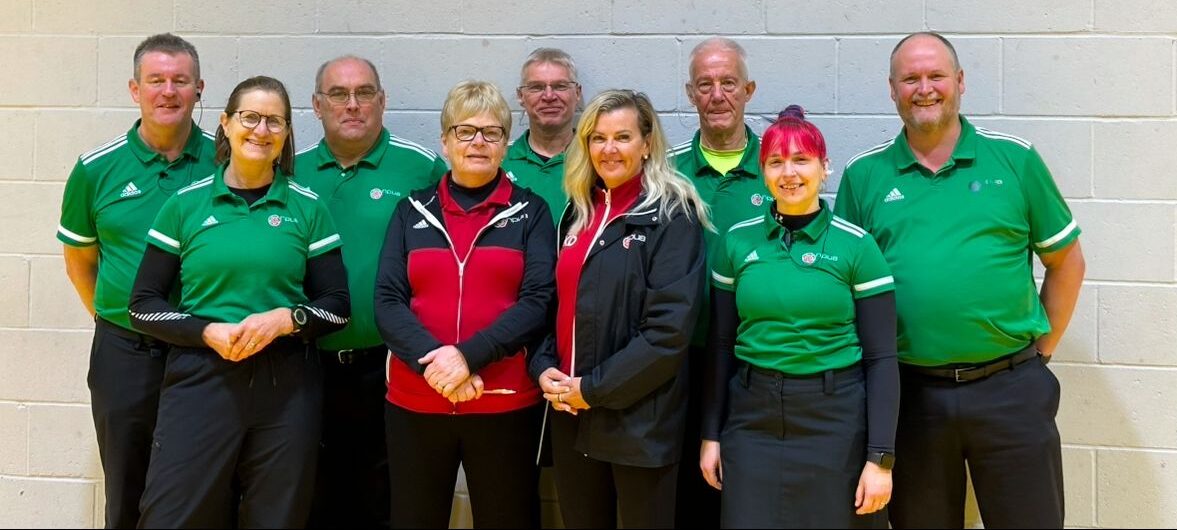
Maidstone Hockey Club Family
“I reached the milestone of officiating 125 National outdoor and over 50 indoor hockey matches as an umpire which was my goal. I still am considered for selection for National Indoor appointments, alongside coaching and developing other umpires as well as umpiring in the SE of England and at my own Club. Over the last year I have umpired at a World Indoor Masters Event and a European Masters event, both in Nottingham so I’m getting to meet even more of the worldwide hockey family.
“Hockey has been a huge part of my life and a huge factor in who I am. I have been involved with my hockey family for almost 50 years now, and they were so important in my recovery. In the time-honoured old-fashioned way of the post-match interview I have to stress just how much of a team effort it’s all been. I remember sitting at the end of my hospital bed, in isolation, cheering at the TV when GB women’s hockey team were winning their Olympic Gold medals. To have all this to return to, and to have done so much since my leukaemia, makes me so grateful.”
Share your story
We want to help people tell and share the leukaemia stories that matter – stories like Sarah’s and stories like yours.
Related posts
8 September 2022
Statement from Leukaemia UK on the death of Her Majesty Queen Elizabeth II
On behalf of the Leukaemia UK team, Chair of Trustees, Chris Corbin OBE, has made the following statement: “We are extremely saddened to hear the news of the death of…
12 October 2022
“Who’s Cooking Dinner?” makes a spectacular return to The Dorchester
On 10th October 2022, Leukaemia UK’s flagship fundraising event, “Who’s Cooking Dinner?”, returned to The Dorchester Hotel. Above: Fiona Hazell, Leukaemia UK Chief Executive, Iona Beastall and Dr Kostas Tzelepis….
18 October 2021
Leukaemia UK drives forward progress for leukaemia research through five new John Goldman Fellowships for 2021
Leukaemia UK announces five new John Goldman Fellows for 2021 to accelerate progress and stop the disease devastating lives.
30 November 2023
Leukaemia UK invests in next generation of blood cancer trial leaders
This week, aspiring chief investigators of future cutting-edge blood cancer clinical trials took to Birmingham for the DIDACT Foundation’s inaugural Clinical Trials Workshop – an event funded by Leukaemia UK….