
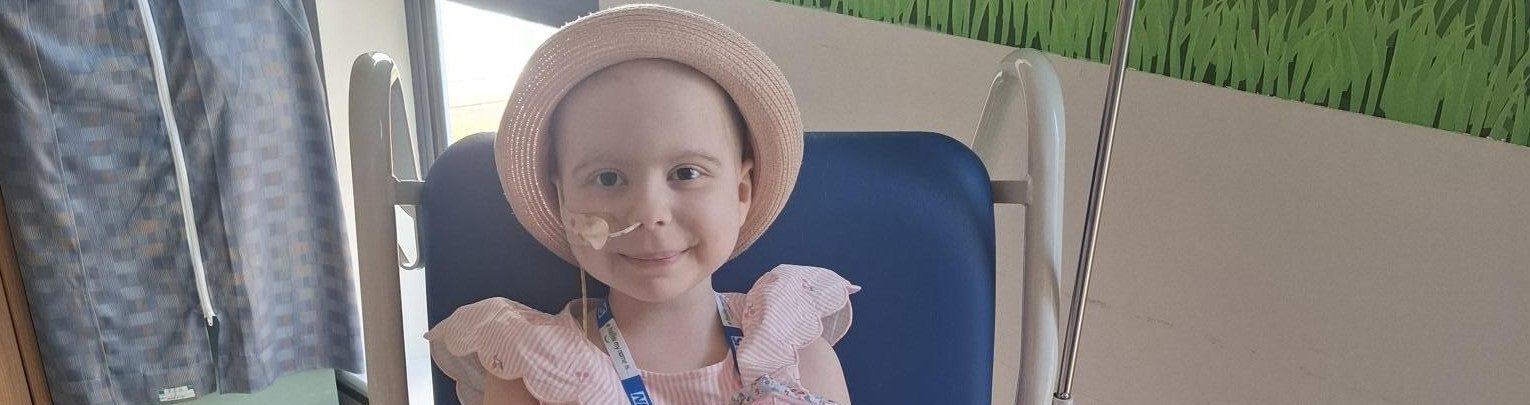
03 Aug 2026
“Nina is amazing and such an inspiration”
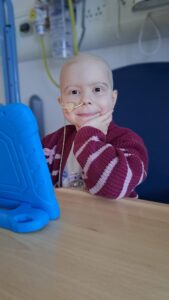
Nina during treatment
Around 530 children under the age of 16 are diagnosed with leukaemia in the UK each year – about one to two each day. All around the country hospitals are doing everything they can to minimise the emotional impact of the treatment on youngsters. Colourful wards, playrooms, specially trained paediatric staff and new friendships with young fellow patients can all help soften trauma of invasive treatment and lengthy stays in hospital.
Nina Hinds was diagnosed with blood cancer just before her fifth birthday, and just seven weeks after she had started the reception class at school.
In September 2025, Nina’s mum, Sam, noticed large unexplained bruises on her daughter’s legs, arms and forehead. As one faded, another would appear. Nina’s eyelids were also an unusual yellow colour, as though they too were bruised.
“She got an ear infection which was treated with antibiotics, but she continued to feel poorly even when it was gone,” said Sam, 38, who lives in Peterborough, Cambridgeshire and manages a children’s nursery. “She was pale, tired and didn’t want to do everyday things for a child her age. She still went to her beloved dance classes but she wasn’t excited by it.
“About a week before she was diagnosed, I took her to soft play with her friend and could see she just wasn’t into it. I remember saying to the other mum there, ‘if I Google her symptoms it says leukaemia, but I know I’m being silly thinking it’s that’. I just thought I was being an overprotective parent.
“Then my husband Daniel picked her up from an after-school club and the teacher said they were concerned about her. She’d fallen asleep in class the previous day, although after I’d taken her home she was full of energy. But they said they felt she wasn’t herself. Daniel rang me at work straight away and said, ‘it’s not just us now’. Now other people were saying something was wrong. So at 4.55pm I did an online eConsult with my GP surgery. At 5pm the phone rang and the doctor told us to come straight in. Miraculously the receptionist had read the eConsult and flagged it up immediately as urgent.”
The doctor said Nina looked anaemic and sent Sam and her daughter to the Jungle Paediatric Assessment Centre at Peterborough Hospital.
“They took more blood tests around 7pm and I asked the doctor all the possible things that could cause anaemia. He listed them and at the end said the worst-case scenario was leukaemia. She was so pale by that time and clearly ill. The test results came back around 10pm and they confirmed her bone marrow wasn’t working properly and that was what she had.
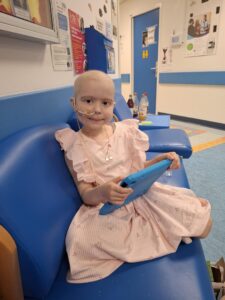
Nina in hospital
“Dan took our elder daughter Ivy, who was eight at the time, to my Mum’s and came back to the hospital. You’d think when you get told your child has cancer you would just burst into tears. But it was such a shock I didn’t cry at all. Daniel was the opposite, he fell to the floor. I didn’t cry until we got to Addenbrookes and then probably didn’t stop for the next two weeks.”
Nina was given an infusion of platelets and transferred to Addenbrookes Hospital in Cambridge around 3am. On 19th October 2025 Nina was diagnosed with B-Cell acute lymphoblastic leukaemia (B-ALL).
“I was scared about everything that was to come. I felt absolutely awful for what my daughter was going through, and what her future held. It also felt like grieving the child I had and everything she was and coming to terms with the fact she’s changed. Fortunately an amazing consultant sat us down, went through everything that was going to happen and was so reassuring. He said Nina was in the low-risk category due to her age, gender and genetics, and she will get through this. Of course it’s always in the back of our minds but it was just what we needed to hear.
“And Nina did really well. She was given blood transfusions which made her feel immediately better and the colour came back in her cheeks, and she enjoyed herself in the playroom. But it was meant to be her birthday party on the Saturday and she was sad we had to cancel that. The nurses sang happy birthday to her and she said, ‘do I look happy?’! She kept her sense of humour throughout it all.”
Treatment started on Monday 20th October – Nina’s fifth birthday. She was given intrathecal methotrexate, vincristine, pegaspargase – chemotherapy drugs commonly used to treat ALL – as well as steroids.
“The induction phase across the first five weeks was hard but it worked. She lost her hair, and lost all movement at one point. The steroids were the worst – they made her grumpy and sad. They also made her stomach and face swell, and they made her so hungry, she was having many dinners throughout the day, including dinners for breakfast! Previous to that in hospital she’d stopped eating so had had a naso-gastric tube fitted.
“We were in hospital for nine days and then were allowed home for the rest of this five week-long first phase. She sat on the sofa, and barely spoke. We had one hospital readmission for a temperature spike and the rest was day appointments. After the induction phase finished, she was off the steroids and we started to see our daughter slowly come back. By Christmas Day she was dancing in the front room on Christmas day. She had a Blina pump by that time and her mobility wasn’t great, but this treatment really changed things.”
Blinatumomab (often called Blina) is an immunotherapy medicine which has been available on the NHS in 2024 for eligible children with B-ALL. Since then it has been expanded and also shows promise for adults. Unlike traditional chemotherapy, it works by helping the body’s own immune system recognise and destroy leukaemia cells. It is given through a ‘Blina pump’ – a small, portable pump worn in a backpack or shoulder bag that delivers the medicine continuously through a drip into a vein, 24 hours a day, usually for 28 days at a time. This allows many children to receive most of their treatment at home rather than staying in hospital.
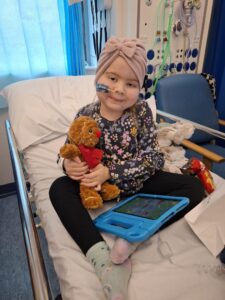 “I initially took around two months off work and Daniel took a couple of weeks off from his job as a mechanic. We then decided to split it so he works 3.5 days and I work 2. This means we equally share hospital visits and Nina’s care. We’ve been together since we were 16 and we didn’t want to be living parallel disconnected lives.”
Nina went back to school for occasional days in January 2026. Sam hopes she’ll return full-time for the start of Year 1 in September when she will be in the maintenance phase of treatment.
“We have tried to send her to school when we can, but it all depends on neutrophils, hospital admissions, chemo blocks, and also illnesses in the class. We can’t go abroad on holiday, Nina can’t visit places with crowds, can’t attend soft plays, swim or use paddling pools, can’t see friends or family often… the list goes on.
“But she’s a really confident little girl and she just got on with it. Her body is amazing, she’s really sailed through it all with only a couple of holds (due to blood counts) and only had a couple of hospital admissions for infections. Although she can’t do all the things a normal five-year-old can do, she’s made friends at school and also friends in hospital, including a couple of little girls who were newly diagnosed when Nina was 4 months in to her treatment. I think Nina really helped those families, they could see the future. She’s quite energetic and is not one to sit on her bed! She will go and talk to people on the ward about her leukaemia.
“Her big sister Ivy also keeps her going. They play together and she’s been amazing. The school has been a great support for Ivy giving her art therapy and putting her in a young carers group where she can talk about her feelings.”
Sam herself found comfort in online groups and social media for parents of children with leukaemia and cancer. She set up an Instagram account Ninas_leukaemia_journey and hopes that sharing her story will help other parents.
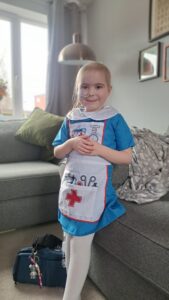
Nina in a nurses outfit
“The first thing I did was go through Instagram and hashtags. I needed to speak to other parents who were further down the line with their child’s treatment to give me hope. Your friends can be there for you but they don’t have any idea what you’re going through. The Peterborough Women’s Football Team have been incredibly supportive and comment on Nina’s stories! We are big football fans and when we go to a game they come and chat to Nina afterwards.
“Daniel has joined a WhatsApp group just for the dads. They don’t always talk about cancer, sometimes it’s football and other things, but he says it’s really helped him.
“Nina is amazing and such an inspiration. She still uses the NG tube for all her medicines, although we are hoping to get rid of it soon and she can take them orally. I always wanted to protect my children from any trauma as I know it can have an effect later in life. But she really does seem to have good memories, which is very comforting. She is now under our local hospital and she misses Addenbrookes and the nurses! Now we just want her to complete her treatment with as few complications as possible, and she can go and live her life like any other normal child. No relapse, no more chemo.”
Share your story
We want to help people tell and share the leukaemia stories that matter – stories like Nina’s and stories like yours.
Related posts
15 June 2018
MP opens Leukaemia UK Ambulatory Care Unit
A unit funded by Leukaemia UK which allows people with blood cancer to have stem cell transplants as out-patients has been officially opened by its first patient, Nick Boles MP
1 August 2022
New research could help detect leukaemia earlier in older people
New research findings, published in the scientific journal Nature Medicine, could help better predict risk of leukaemia in older people and ultimately improve early diagnosis of the disease. The research…
18 October 2021
Leukaemia UK drives forward progress for leukaemia research through five new John Goldman Fellowships for 2021
Leukaemia UK announces five new John Goldman Fellows for 2021 to accelerate progress and stop the disease devastating lives.
6 March 2024
TV baker Juliet Sear announced as Leukaemia UK Ambassador
Leukaemia UK is excited to announce long-time supporter Juliet Sear as their latest celebrity Ambassador. Juliet, who has been an enthusiastic supporter of Leukaemia UK for several years now, wanted…