
04 Aug 2026
How life changed for Alex Williams
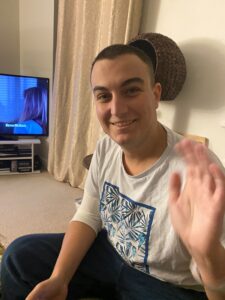
Alex Williams
Leukaemia changes lives beyond all recognition. Dealing with the shock of diagnosis, saying goodbye to the past and shaping a new life beyond recovery, for some people can take many years.
Here Alex Williams talks poignantly about how life has changed for him, after he first noticed symptoms in February 2019.
“I was travelling in my job as a financial analyst for an American technology company when I developed a numb patch in my jaw,” said Alex, who is now 35, and lives in Canterbury. “A few weeks later, I found a lump on my forehead.
“By March it hadn’t gone so I booked an appointment with my GP. He briefly inspected the lump and told me that it was probably a cyst that may resolve itself. He said either way it was a purely cosmetic issue that wouldn’t be dealt with by the NHS. I wasn’t offered any tests.
“It didn’t go away and in May I began to experience extreme nerve pains in the section of my jaw that was numb. They typically happen over several hours during the night and kept me awake. I started to feel exhausted as well but put this down to disrupted sleep. I saw my GP a number of times over the following months about the increasing pain I was in. I was told it was trigeminal neuralgia. My GP said that since the cause of this pain was rarely identified, he would focus on treating the symptom. Over the next few months I was prescribed increasing doses of various medications, but no tests were ever performed. The drugs were ineffective, and I spent hours each night in terrible pain.”
Alex also saw a dentist who took his symptoms seriously and referred him onto the NHS cancer pathway. But because the dentist was in a different health authority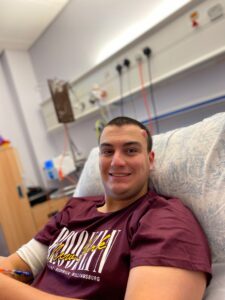 to the one in which he lived, what should have taken two weeks took around six.
By then it was August 2019, and Alex decided to pay for private cosmetic surgery to remove the lump on his forehead. When the surgeon started the operation she found unusual tissue and called a halt. She sent a sample away for testing, saying the results would be back in a few weeks.
“I didn’t get any results and actually after my diagnosis I followed up with the clinic and was told that the sample had been lost in transit almost immediately. In the meantime the pain in my jaw continued and in September I got a private referral on my work health insurance to a maxillofacial surgeon, who referred me for scans and blood tests.”
Alex was then referred back to the NHS and at the start of October was told he had cancer at the maxillofacial department of the Royal Berkshire Hospital in Reading, near where he was living at the time. Further tests were done and on 31st October 2019 he was diagnosed with B-cell acute lymphoblastic leukaemia (B-ALL). He was 29 at the time and this rare type of leukaemia is most common in children and older people – 65% of cases are in under-25s and 13% in the over-60s (figures from NICE). The lump and nerve pain had both been caused by masses of white blood cells on his trigeminal nerve, in an unusual location.
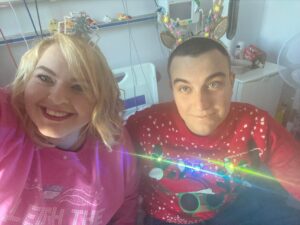 “Maybe the rarity delayed the diagnosis as it wasn’t what they were looking for – I will never know. I was too shocked to really process the news. My fiancé Charlotte was with me at the appointment, so my strongest feeling was anxiety about telling my parents. In the same conversation, I was told that I would need to be admitted to a hospital for an extended period. I was given a blood test to determine whether I needed to be sent to be admitted immediately. This was another big shock, as I’d been told initially the investigations had been indicating a much more treatable form of cancer. Charlotte and my parents were distraught. It seems silly in retrospect, but I couldn’t quite believe that I was seriously unwell. I’m not sure I ever really took this prospect on board.
“I was diagnosed on a Friday. Because my bloods looked good, they said I could go home and be admitted to hospital and begin treatment on Monday. I messaged my boss in the States and explained I was very ill and would need time off work. Charlotte had just finished a Masters. She was doing job interviews at the time but put her career on hold. We were very lucky to be in a financial position to cover that. It’s hard enough when you don’t need to worry about that – I don’t know how people cope if there’s financial pressures too.”
Treatment for Alex consisted of steroids, various forms of oral, IV and intrathecal chemotherapy (chemotherapy administered into the fluid around the spinal cord during a lumbar puncture), and prophylactic treatments.
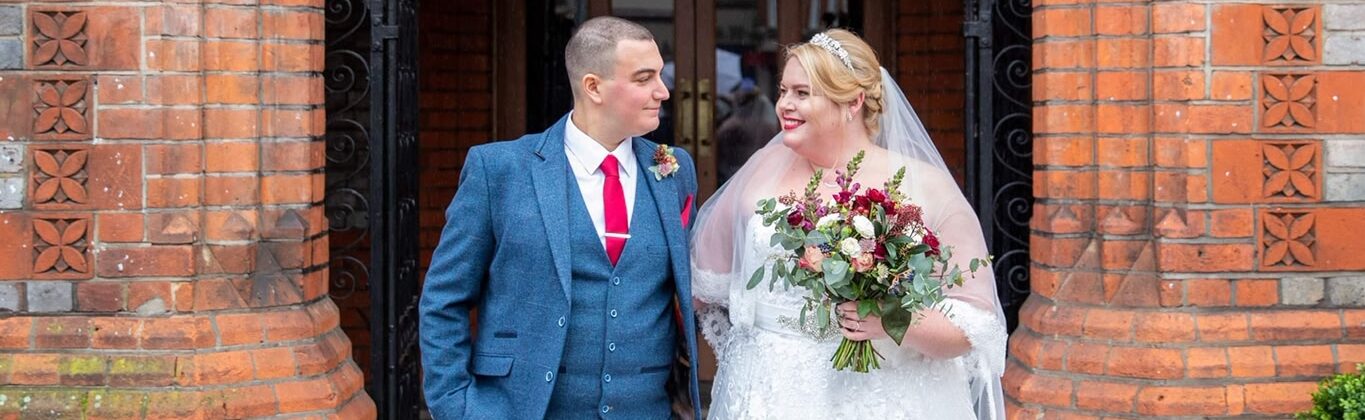
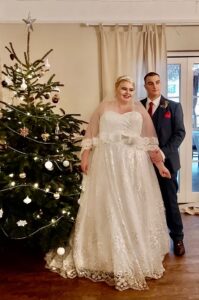
“Due to my immunosuppression, I was confined to a single hospital room for 14 of the next 18 weeks. I was isolated, uncomfortable, miserable and, eventually, angry. Initially my test results looked a bit dodgy and there were doubts if I’d be around long term so Charlotte and I decided to move our planned wedding forward from September 2020 to December 2019. She did an amazing job putting it together in a few weeks and I was released from hospital for 24 hours to go to the Town Hall.”
 Alex eventually returned home in February where he continued on oral chemotherapy. The covid pandemic kicked in shortly afterwards, which meant he and Charlotte spent the best part of the next two years in almost total isolation.
“I was very high risk. We saw virtually no one except doctors. It was incredibly tough. I had a huge carrier bag of pills, and three visits to hospital a week, and that was our lives. There was the constant fear of sepsis and covid and infections. I did start to feel better but was still exhausted in a way I can’t describe. Fortunately, my blood tests showed a steady upward trajectory from the start, and again I am so grateful for this.”
Alex ended active treatment at the three-year mark. By the time he was ready to go back to work his former job had been filled. The company created a new role for him but he struggled to adapt.
“I felt like I didn’t belong anymore and was pretty unhappy. Everyone I worked with had moved on and it was a totally different place. I resigned after six months. I had a critical illness insurance policy which started as soon as I was diagnosed and which covered me for five years. Fortunately as we did virtually nothing we could save substantial amounts of money from that. I am currently considering going back to work at the moment though.”
While Alex was told his treatment might have left him infertile, this proved not to be the case. In 2025 baby Emily arrived.
“It’s been such a hard road but I also know how very fortunate I have been. Emily is just about to start walking now. I’m lucky enough to have been a full-time father to her.”
Seven years since his diagnosis Alex just has an annual appointment to monitor his health. While physically life has returned to normal, the effect on his mental health has been much longer lasting.
 “I have been told that the risk of relapse is now low. Even though I was very lucky with my treatment outcomes, leukaemia ended the life I had before my diagnosis. Two years of extreme social isolation during covid was terrible. The career I had before is gone, and I was always an ambitious, career-focused person. Almost all of the friends, colleagues and acquaintances I had before cancer are no longer a part of my life. People just dropped off the radar with no explanation. Many of the relationships that have lasted have been re-contextualised. There’s been a lot of loss and little closure. Maybe without covid it would have been different.
“There has also been a strangely emotionally-taxing adaption to ending treatment. Of course it was a big important milestone, but all the structure I’d had fell away. I wasn’t working, and taking pills and going to hospital were the structure. But the world hadn’t just been waiting for me. It had moved on.
“I moved home to have better access to treatment and be closer to family. I have a new life now, with an expanded family and some new friends, but it was profoundly dislocating. I still struggle with how abrupt all that change was, and feelings of loss related to it. However I’ve taken the time to do plenty of travelling now I can. We got a dog and now have three. I built structure and purpose back up again. I feel so lucky to have my daughter, and I want to be the best dad I can to her.”
Share your story
We want to help people tell and share the leukaemia stories that matter – stories like Alex’s and stories like yours.
Related posts
16 November 2022
Leukaemia UK and Leukaemia Care urge benefits to be raised in line with inflation
Leukaemia UK and Leukaemia Care have written to the Chancellor to highlight the additional financial pressures faced by blood cancer patients and their families, ahead of the Autumn Statement this…
8 July 2025
The first ever leukaemia-dedicated pathway to improve diagnosis, treatment and care
The Best Practice Timed Pathway We’re delighted to share that Leukaemia UK, in partnership with Lymphoma Action and Myeloma UK, is working with the NHS England Cancer programme team to…
9 May 2018
Sharing this exciting news: a treatment advance for childhood leukaemia
A deal has been struck to let the NHS offer children an expensive new cancer therapy that has been called the most exciting treatment advance for decades
18 November 2024
Leukaemia UK’s Patient Care Pioneer Award fuels innovative research to revolutionize ‘watch and wait’ approach
Leukaemia UK is excited to announce Professor Francesco Forconi from University Hospital Southampton (UHS) as the first recipient of its Patient Care Pioneer Award. Through this new funding initiative, Professor…