
27 Apr 2026
Chris’ diagnosis ended up coming almost by accident.
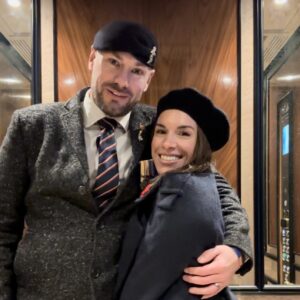
Chris and his wife Laurie
In 2014, Chris Dawson was a young, fit 27-year-old sergeant in the British Army. He was also living with leukaemia – he just didn’t know it yet.
For around a year before his diagnosis, Chris had been feeling dizzy after exercising and was very tired. Then he was put forward for a promotional course in the army and unexpectedly failed the required fitness test.
“I failed the timed mile and a half run by seconds,” said Chris, now 38 who lives in Chelmsford and works as engineering manager. “I was exhausted and dizzy. I couldn’t understand how it had happened. But instead of thinking something was wrong, I was embarrassed and assumed it was my fault. I just thought ‘I need to train harder’. In the Army you don’t think, ‘I’m ill’, you think, ‘Man up’.”
Chris increased his training but also started napping after work, attributing the tiredness to his increased physical output. On top of this, he had just become a dad for the first time and was dealing with what he thought was the normal exhaustion of having a newborn. Then one evening, Chris lay down and noticed something unusual.
“One side of my abdomen sat higher than the other. It looked wrong. I Googled it, laughed at the worst-case answers, and thought, ‘Not me’.”
Chris’ diagnosis ended up coming almost by accident. Towards the end of a training session, he had to perform a fireman’s carry but when he lifted his friend onto his shoulders, a spinal disc prolapsed and he was sent to the Army doctor. During the examination of his back, he mentioned the swelling and, after suggesting it did look ‘odd’, the doctor ran blood tests.
Later that evening Chris woke to multiple missed calls and a message telling him to go to hospital immediately. The lump in his abdomen was his spleen, enlarged to four times its normal size as it struggled to deal with the extra white blood cells his body was producing.
Chris went immediately to Colchester Hospital where he was given more blood tests and a bone marrow biopsy. The next day, 10th July 2014, Chris was diagnosed with chronic myeloid leukaemia (CML).
CML is a rare type of blood cancer, accounting for around 10–15% of all leukaemia cases. It is a slow-growing cancer that starts in the blood-forming stem cells in the bone marrow. These stem cells normally develop into different types of blood cells, but in CML they produce too many abnormal white blood cells. CML is more common in older adults, with a typical age at diagnosis of around 60–65. This makes Chris one of only around 120 patients under 40 diagnosed in the UK each year.
“The doctor told me he didn’t know how I was still standing,” Chris said. “My white blood cell count was dramatically escalated.”
“It was early in the morning, before my family came back for the day, so I was on my own. The first thing I actually did was ring my brother. I was crying at the time and he’s a very pragmatic person, and we’d become very close as adults. He said “well you’re not dying right now are you, chin up and we’ll sort it out”. I had a very different mindset back then, shaped by being in the Army, and in that moment that’s what I needed to pull it together and find out more facts rather than just presuming tomorrow I’d be a tombstone.”
Chris had to stay in hospital for two weeks. He was given chemotherapy followed by targeted drugs known as TKIs (tyrosine kinase inhibitors). Tyrosine kinase inhibitors (TKIs) treat CML by blocking the abnormal protein (BCR-ABL) that drives the disease. In CML, a genetic change creates the BCR-ABL tyrosine kinase, which sends constant signals telling white blood cells to grow and divide uncontrollably. TKIs bind to this protein and switch off its signalling, which stops the overproduction of abnormal cells.
No one could tell him what his long-term prognosis would be at that point and this meant that Chris would be classed as non-deployable in the Army.
“The Army defined me. I joined at 16. It was who I was. But the whole point of being in the Army is to be deployed. If I couldn’t guarantee them that then how could they keep me in?”
Normally, a soldier leaving the Army receives around a year of structured transition support including everything from career guidance and training to work placements and financial advice, with the emphasis on gradual reintegration into life as a civilian. But Chris panicked and asked to leave immediately.
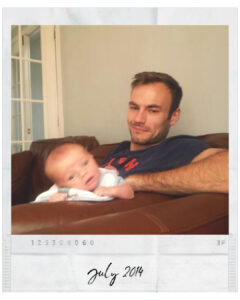
Chris and his baby
“I had just taken out a large mortgage and I had a one-month-old baby. I’d worked since I was 14 and in my mind I needed to move on quickly, get a job and a new and unexpected career. I had to provide for my family. Ironically when we’d taken out the mortgage we’d declined the medical and life insurance so there was no back up. In retrospect I wasn’t thinking straight and it was a very hasty decision but fairly soon I was back doing hard physical jobs, at the same time as adjusting to the early months of my cancer treatment.
“The civilian world was completely different. Not technically difficult, but culturally. HR, behaviour, communication. I was out of my depth and I didn’t even realise it. I took on any work I could get, even scaffolding and lorry driving. While I should’ve been resting I was pushing harder than ever in a bid to keep everything together for my family. Within six months I’d become a dad, got diagnosed with cancer and abruptly exited the Army with no transition. Unsurprisingly, my mental health starting deteriorating rapidly.
“I didn’t even believe in mental health issues before that. I thought it was weakness. Looking back that abrupt exit had consequences. I was Chris Dawson, but I didn’t want to be Chris Dawson any more. I wanted to be anyone else. I just wanted to run away from my own life.”
Chris eventually found a job as an engineering manager but it was a three-hour daily commute. His marriage broke down and he rented an apartment but his parents noticed him sinking lower and lower and asked him to move in with them.
“I ended up signing on for benefits which was a breaking point. I’ve had everything and lost it. I’d worked since I was 14 and the Army had my life mapped out infront of me. It

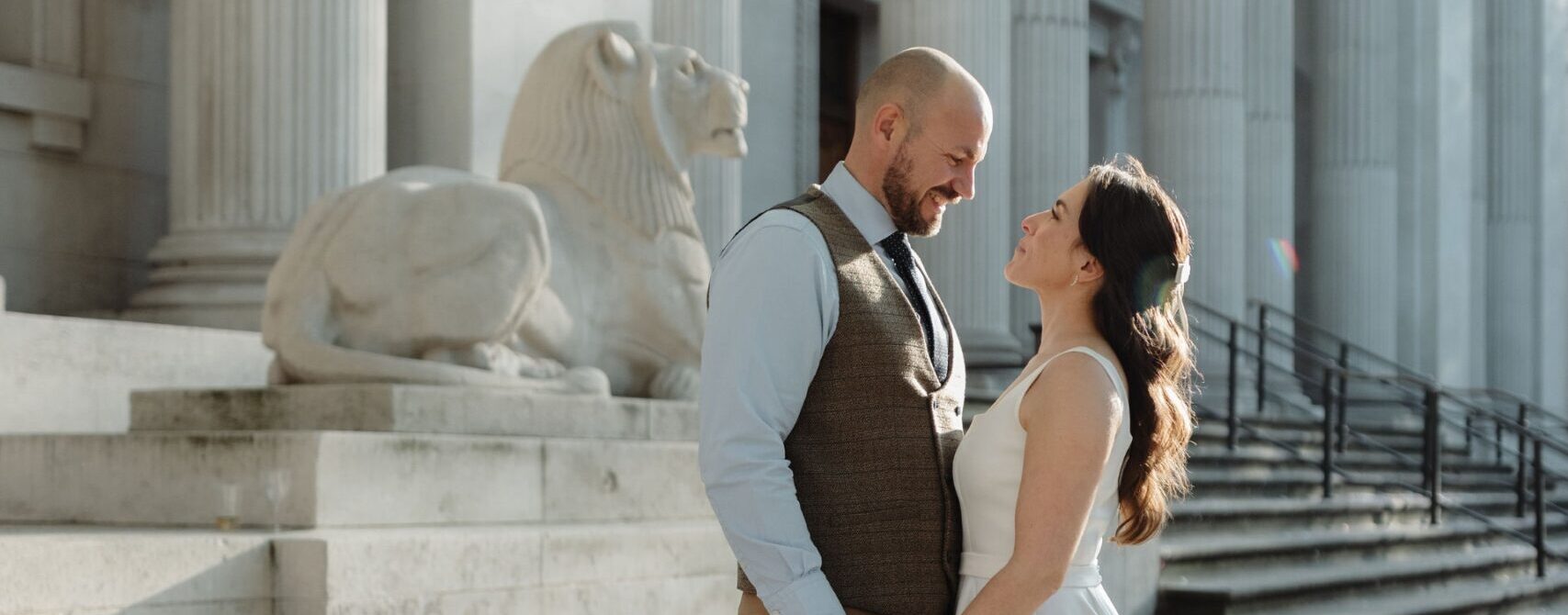
Chris and Laurie’s wedding day
made me and even now I still mourn the loss of it. But my parents were patient with me and eventually a recruiter put me forward for a position with an automotive engineering company. I got the job, and eight years on I’m still there. I’ve been promoted a number of times and they’ve helped me find myself.”
On top of his mental health struggles, Chris’ physical recovery took much more time than the doctors had expected. The blood results they had hoped to see in six months took six years. There were three changes of medication protocol to try and achieve the correct numbers and also reduce side effects like bone pain and rashes.
“I moved hospitals from Essex to Basildon but eventually my dad suggested I looked at Hammersmith in London as that’s the centre of excellence. They’ve been fantastic. I’ve now been on Dasatinib for the last six or seven years and really can’t pinpoint any side effects apart from normal tiredness from having three kids, a busy job and going to the gym or running as much as I can! For years I assumed I wouldn’t live past 60. No one had told me otherwise. But now I can see more of a future.”
On 16th April 2022 Chris and Laurie got married. He sees his consultant every three months but is now living a full life that once felt out of reach.
The treatment for CML (TKIs) were only given full approval for use in 2001, so there are few people of Chris’ age who have been on this targeted treatment for this long.
“At an appointment in 2022 we finally were told there was no reason Chris shouldn’t expect a normal life expectancy,” said Laurie. “This was eight years after diagnosis. In a very surreal moment, this was also the appointment that he was advised he could return to full-time employment. We laughed!”
Recently, Chris was also offered the possibility of treatment-free remission, meaning that if his blood markers remain stable, he may be able to stop taking daily medication under close supervision. While Laurie was ecstatic at the news her husband had almost recovered after 11 years, Chris felt strangely lost.
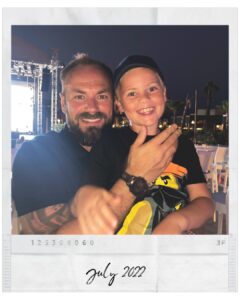 Laurie said: “When we talked about it he said ‘it took so much away from me – if I don’t have cancer any more, what was it all for?’. That sentence stayed with me. In a strange way, CML defined him and became his reason for needing to start his life over again. The idea of removing that from his identity feels unexpectedly unsettling.”
On the advice of his professors, Chris has elected to stay on his treatment for at least a couple more years to allow for more data to be processed for people his age.
But to mark his incredible recovery, Laurie’s employer, tech HR company Zinc, is now taking on a challenge to raise money for Leukaemia UK, in the knowledge that research into targeted treatments like TKIs is the reason Chris is here.
During April 2026 a group from Zinc will be canoeing for three days to raise money for Leukaemia UK, with each participant aiming to raise at least £500 to support their work funding life-saving blood cancer research. They’re paddling 66 km along the Thames, from Abingdon to Henley, and Zinc will match all donations.
“Everyone thinks their partner is incredible, but Chris’ story (or CJ, as his family know him) is truly remarkable,” added Laurie. “The bravery he has shown through more than a decade of uncertainty, is beyond anything I think I’d personally be able to match.”
Share your story
We want to help people tell and share the leukaemia stories that matter – stories like Chris’s and stories like yours.
Related posts
19 June 2023
Leukaemia UK research paves the way for personalised lymphoma treatment
Despite promising trials, standard treatment for diffuse large B-cell lymphoma (DLBCL) hasn’t changed in a decade. New treatment strategies for this type of blood cancer are urgently needed. Could the…
24 August 2022
Non-existent awareness of leukaemia symptoms “extremely worrying” – say leading UK leukaemia charities, as they launch memorable new campaign to get people “parroting on” about the symptoms
People over 55 also underestimate their risk, thinking that leukaemia is a childhood disease. Only 11% of over 55s thought that they had the greatest risk of leukaemia[1], whereas in…
30 November 2023
Leukaemia UK invests in next generation of blood cancer trial leaders
This week, aspiring chief investigators of future cutting-edge blood cancer clinical trials took to Birmingham for the DIDACT Foundation’s inaugural Clinical Trials Workshop – an event funded by Leukaemia UK….
8 November 2022
Leukaemia UK announces John Goldman Fellows for 2022
Leukaemia UK has awarded their prestigious John Goldman Fellow research grants to four outstanding early-career researchers seeking to advance our understanding of and ability to treat blood cancer. Leukaemia UK…