
14 Jan 2026
Andrew’s attitude and position from the word go was to ‘give back’ and help others.
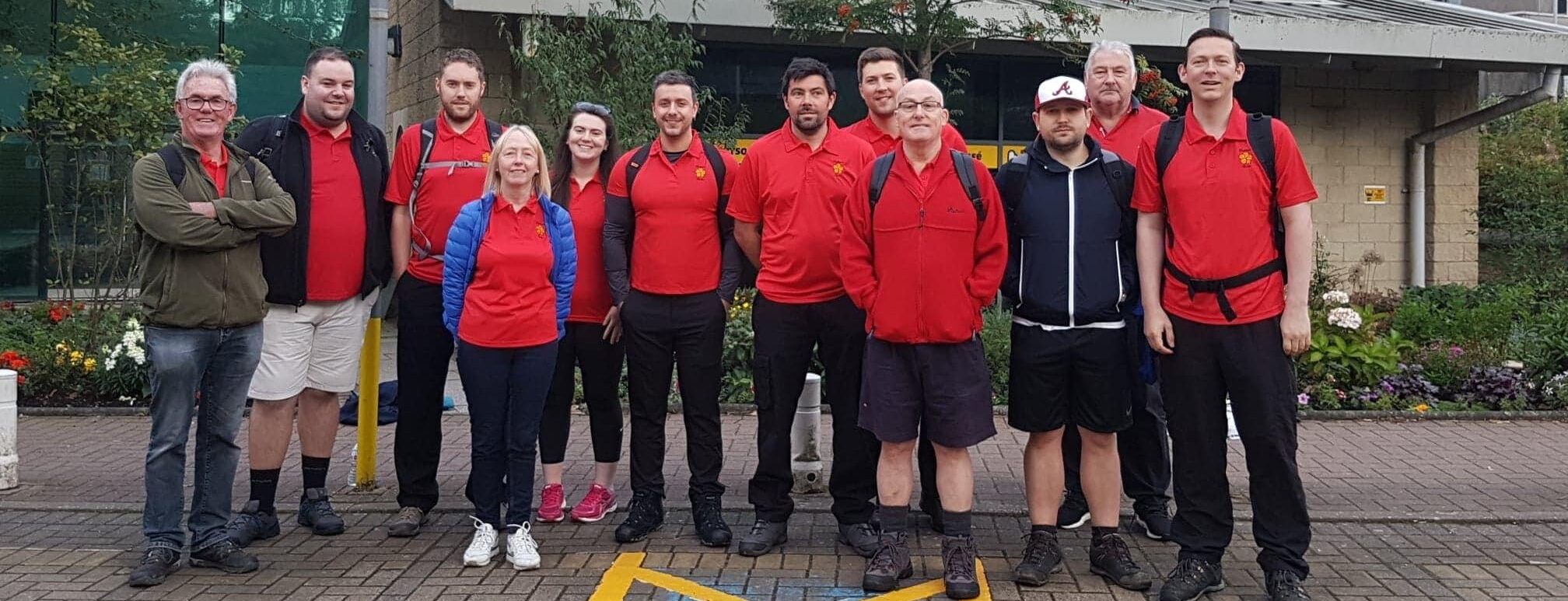
At the time he was diagnosed in November 2017, Andrew Fairweather was a fit 33-year-old man who worked for a facilities management company and had a passion for fundraising for charities. He and his father Roy had walked round Loch Lomond in June that year to raise money for MacMillan Cancer Care. Andrew was also looking forward to becoming a dad, as his wife of five years Emma was heavily pregnant. But then, out of the blue, he developed fatigue and a cough.
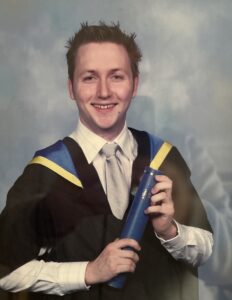
Andrew Fairweather before his diagnosis
“He visited the GP who was immediately suspicious as to why a fit young guy was so tired,” said Roy, who lives in Stenhousemuir, Falkirk. “Fortunately the GP gave him an immediate blood test which came back the next day. My wife Stella and I got a phonecall on the Tuesday night at 9.45pm to say he was in Forth Valley Royal Hospital, near to where he lived in Grangemouth. We went straight there and were told the terrible news he possibly had leukaemia.”
At first doctors suspected it was acute myeloid leukaemia (AML) but then changed their diagnosis to T-Cell acute lymphoblastic leukaemia (T-ALL) which is extremely rare in Andrew’s age group. Only about 30 people aged 25-39 are diagnosed with, T-ALL a year in the UK. T-ALL is an uncommon and highly aggressive form of blood cancer affecting the T-cells of the immune system.
“The sky fell in. We felt such disbelief at first but then quickly had the realisation that we just had to support Andrew. It was his feelings which mattered. But as parents the feeling of helplessness was overwhelming at times. Andrew’s wife Emma was also 24 weeks pregnant and you can imagine the feelings we had thinking about that.”
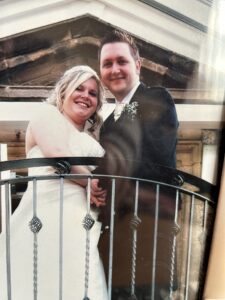
Andrew and his wife on their wedding day
One week later Andrew was admitted to the Beatson West of Scotland Cancer Centre in Glasgow.
“The doctors were brilliant and explained everything to us. The cough he had was found to be caused by a large mass on his chest which was due to leukaemia, which came as a huge shock. He was transferred to the Queen Elizabeth University Hospital, Glasgow, treated for that successfully, and then came back to the Beatson.”
Andrew was given three rounds of chemotherapy.
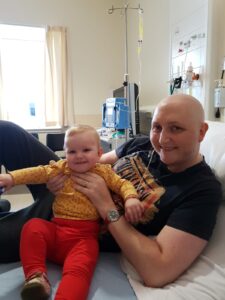
Andrew in hospital with daughter Abigail
“He was doing so well after the first round that they allowed him to go home for the second round and just come to the hospital every day. His figures in his blood tests were great and we were so positive. They took deep bone marrow samples which they sent to London which showed no leukaemia. He was, however, very weak at that point and had to be very careful with infections but he managed to get to the maternity hospital in January, just before their daughter was born, and was there to see her arrive. But apart from the weakness and fatigue he was hardly sick and managed well with the treatment. All through his treatment he never complained – not once! They gave him a third round just to make sure and then put him on chemotherapy tablets for maintenance. By that time it was June 2018 and he came home.”
However the positive outcome tragically wasn’t to last. Andrew started to develop more infections – firstly around his PICC line (the thin, flexible tube inserted into a vein in the upper arm to provide long-term, reliable access for treatments like chemotherapy or blood tests) and then E.coli in his digestive system. Hospital treatment was required for each, alongside regular blood and bone marrow tests to monitor his leukaemia. In September 2018 a routine test revealed he had relapsed.
“His gums had started to bleed by that point but other than that he was well in himself and was even thinking of going back to work. It was of course terrible news, and they told us he would now need a stem cell transplant. They started him back on chemotherapy and found a stem cell donor who was a 10/10 match in America. But they couldn’t get his blood levels down low enough to start the treatment. They tried him on Nelarabine which is expensive and the hospital had to get approval to use it from the Scottish Government. He was funded for four doses but he only managed two and wasn’t responding.”
Andrew passed away on 21st March 2019 in the Strathcarron Hospice.
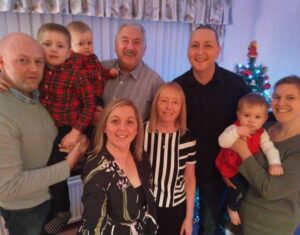
Andrew and his family during treatment
“During his treatment we used to drive 25 miles there and back every day from home to the Beatson in Glasgow. We had lots of time to talk, and his attitude and position from the word go was to ‘give back’ and help others. Fundraising for charities is in our DNA as a family and we’ve always done it. When he eventually got the bad news this intensified and he started to talk about his legacy – the giving back. When we lost him, Stella and I decided to set up a memorial-type organisation, Andrew’s Wish, to raise awareness about leukaemia and also raise money for research. We chose to support Leukaemia UK. You were so helpful to us with information and we believe all the research work that will eventually lead to people like Andrew having another chance.”
Andrew’s Wish has since gone from strength to strength. Roy and Stella developed a little badge showing a forget-me-not flower in orange Leukaemia UK colours. The couple sent the badge out to their large network of family, friends, work and golf club contacts, asking them to wear it wherever they go in the world and to send back photos.
“I post the pictures on Facebook, and that spreads more awareness. When wearing the pin they also have to tell Andrew’s story to people they meet. The response we have had is amazing – it energises us to do more. My background is in banking but more recently I’ve worked all over the world for an international environmental management group. So many of my contacts have pledged support, worn the badge and sent pictures.”
Roy and Stella have also held fundraising events for Leukaemia UK including walks, cycle rides and golf days. Over the years they’ve raised an incredible total of more than £25,000.
“The biggest one was the ‘100 holes of golf’ led by my niece Alison Davidson who is a past Scottish and British Women’s Amateur golf champion as well as a Curtis Cup player. That raised
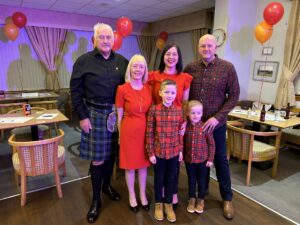
The family fundraising for Leukaemia UK
£15,000. Andrews friends all get together every year before Christmas for a ‘Lethal Weapon’ day to watch all of the films, raise a glass to Andrew and raise money. We’ve also done walks from our house to the Beatson, the route we drove for his treatment every day. Next year we will host a Leukaemia UK fundraising day at my golf club, as well as other walks and events.
“We’re OK. We have our moments-but this gives us a sense of purpose. We go up to the cemetery and put flowers down. He’s got some other family members around him so he’s got good neighbours. It helps to keep giving all we can give with our fundraising and keeping Andrew’s memory and legacy alive. I think he’d be delighted with what we’ve done, and if he’d been here he would have loved nothing more than being involved at the centre of it all.”
Share your story
We want to help people tell and share the leukaemia stories that matter – stories like Andrew’s and stories like yours.
Related posts
11 February 2026
The National Cancer Plan: what does it mean for people with leukaemia?
The Government’s new National Cancer Plan for England, which launched on World Cancer Day 2026, marks the most significant progress in policy for leukaemia and other blood cancers in more…
1 August 2022
Pedalling pair’s crazy peaks challenge to stop leukaemia cutting short the lives of beloved mums
Leukaemia UK supporter, Alistair, who lost is mum to leukaemia less than a year ago, is setting out on an extreme fundraising challenge. Alistair, who is from Lincoln, and his…
21 September 2022
A record year for Leukaemia UK London Marathon runners
62 runners put their best feet forward for Leukaemia UK A record 62 runners are taking part in this year’s London marathon to help fund vital research into leukaemia diagnosis,…
21 August 2023
Jelly bellies, yellow teeth and hairy ears – parents reveal the most EMBARRASSING questions their children have asked
A new survey has revealed the most embarrassing, awkward and often hilarious questions that parents or grandparents surveyed have been asked by children. The survey was undertaken by charities Leukaemia…