
17 Feb 2025
Advocate for change: Joseph’s story
Leukaemia UK Community Champion Joseph Beaver has a rare type of leukaemia. His condition was discovered by chance when he was having tests after being hospitalised with another rare condition – Guillain-Barre Syndrome. Guillian-Barre causes muscle weakness when the immune system attacks the peripheral nervous system. Joseph had suddenly developed the facial paralysis during a trip to the cinema on Boxing Day 2021 with wife Belle, following a few weeks of headaches, pains and fatigue.
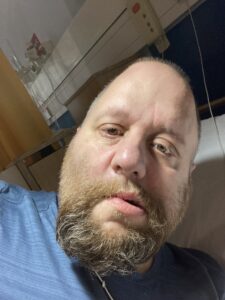 “It was terrifying,” said Joseph, 49, who is now based in his hometown of Glasgow, but was living in London at the time and working at Gatwick Airport. “My whole face was paralysed, I couldn’t close my eyes and couldn’t speak properly. I also started to lose power in my legs.”
Joseph immediately went to A&E at Northwick Park Hospital in Harrow, where he ended up staying for two weeks.
“My life completely changed in hours. I was in hospital having to have my eyes taped up as I couldn’t close them. I had a barrage of tests every day and doctors initially thought I had Central Nervous System Lymphoma. They told Belle before me, and also warned her that I might not survive. After lumber punctures and a bone marrow biopsy they diagnosed Guillain-Barre Syndrome and I was allowed to go home to continue treatment at home. But I kept returning to the hospital for physiotherapy to get my mobility back as I was using a walker at that point, and also further tests. It was during one of these in August that they officially diagnosed me with T Cell Large Granular Lymphocytic Leukaemia (TLGL).
“It was a total shock. They had suspected leukaemia months earlier but they had then ruled it out. I immediately thought I was going to die. I was extremely emotional at the time. But the haematology consultant reassured me it was very slow growing – I would most likely die with it rather than as a result of it. I didn’t need any treatment and they would just monitor my bloods.”
At the time, Joseph was training to be a detention custody officer, but had to give up work because of his medical problems. In summer 2024 he and Belle decided to move back to Glasgow with Belle’s three children. Joseph now works as a customer assistant behind the tills at Tesco. He’s recovered most of his mobility although still experiences pain in his back.
“I have six monthly appointments on the phone with the haematologist at Northwick Hospital and am waiting for them to transfer me to the hospital in Glasgow.”
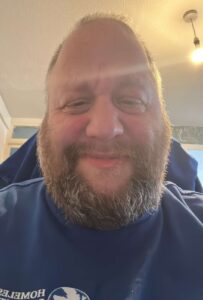
“My condition is what they call indolent and not requiring treatment at the moment. But being ill has affected my family life a lot. I was only married a couple of months before I became ill. My wife and stepdaughter looked after me a lot and were there for me. I used to be morbidly obese and had bariatric surgery and went on to enjoy running and even took part in the Great Scottish Run. So it’s affected my fitness again and the doctor is keeping an eye on my weight.”
“Speaking to people on social media who also have T-LGL has helped me a lot. And my doctor reassures me if my blood levels deteriorate there is a simple treatment that involves taking tablets. But that may never happen.”
“People look at me and say how has he got leukaemia? But I make sure I wear my Leukaemia UK ‘Spot Leukaemia’ t-shirt during the annual campaign. I am doing all I can to remain healthy for a long time to come.”
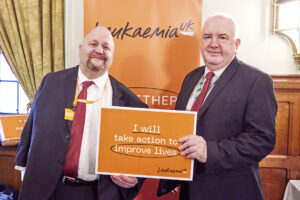
Joseph representing Leukaemia UK as a community champion in the Houses of Parliament
Joseph has done over 30 years of volunteering at events and festivals and with community organisations. When he heard about Leukaemia UK’s Community Champion scheme he decided he would like to get involved.
“I’m enjoying being an advocate for change and representing all leukaemia patients in Scotland. I’m looking forward to visiting the Scottish Parliament. Mine is a rare type of leukaemia and I don’t look like I have cancer. But it still affects you, and we all need to have a voice.”
Related posts
6 June 2022
An open letter to people with a weakened immune system
Leukaemia UK joins the NHS and other charity leaders by signing an open letter, to encourage people with a weakened immune system to continue to book in or visit a walk-in centre for their Covid-19 vaccines.
8 September 2022
Statement from Leukaemia UK on the death of Her Majesty Queen Elizabeth II
On behalf of the Leukaemia UK team, Chair of Trustees, Chris Corbin OBE, has made the following statement: “We are extremely saddened to hear the news of the death of…
14 March 2023
Percy & Nell says Pants to Leukaemia with bespoke charity collaboration
Independent clothing brand Percy & Nell has produced a unique range of sweatshirts, t-shirts, beanies and tote bags, with all profits going to Leukaemia UK. The collaboration comes off the…
18 October 2021
Leukaemia UK drives forward progress for leukaemia research through five new John Goldman Fellowships for 2021
Leukaemia UK announces five new John Goldman Fellows for 2021 to accelerate progress and stop the disease devastating lives.