First-of-its-kind study combines computer modelling and laboratory experiments to uncover new insights into CLL

Simply put this publication looks at how CLL cells hide from medications outside the circulation, and which signals help the CLL cells do this.
Medications that block the B-cell receptor (BCR) pathway - such as Bruton’s tyrosine kinase inhibitors (BTKi) – have drastically changed outcomes for patients with chronic lymphocytic leukaemia (CLL). Some of these treatments work by disrupting these signal pathways, helping to flush the CLL cells out of their hiding places and into the bloodstream, where they are easier to target.
Think of the CLL cells as enemy soldiers, either out in the open (the circulation) or in heavily fortified buildings (lymph nodes and other lymphoid tissues). While the CLL cells are inside, they receive signals from their surroundings that help them survive and are harder for certain treatments to eliminate. Some medications essentially flush the soldiers out of the bunker, by cutting these signal pathways. The CLL cells are pushed out of the protective lymphoid tissue and into the open field; the bloodstream. Once they’re out in the open, it is much easier for certain medications to find and target them directly.
CLL is the most common adult leukaemia and despite these advances in treatment it remains incurable and a lifelong condition. Although some therapies have revolutionised treatment, the results for patients can be highly variable. And BTK mutations only explain a proportion of why resistance occurs, in fact 20-30% of patients who relapse have no detectable mutations which would cause resistance to medication – meaning that clinicians are not sure of why the patient has relapsed.
This led Dr Kennedy, Prof. A. Pepper, Prof. C. Pepper and Prof. S. Mitchell to the line of thought that other signalling pathways must play a role. Currently, there is no reliable way to predict how well a patient will respond to treatment with a BTKi alone. It is also unclear why small numbers of cancer cells can remain after treatment in some patients. Studying and understanding how cancer cells communicate and respond to signals, could help researchers better predict how well treatment will work.
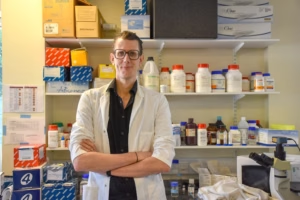
To investigate these unanswered questions, Professor Simon Mitchell, who received a Leukaemia UK John Goldman Fellowship in 2020, worked with Professor Pepper’s team to combine computer simulations with laboratory experiments. Computer simulations allow researchers to recreate diseases virtually and test ideas more quickly, helping them understand what might be happening inside cancer cells before investigating further in the laboratory.
Their recent research, published in Blood, explored how two signalling pathways, called BCR and Toll-like receptor 9 (TLR9), work together. TLR9 is a receptor inside CLL cells that recognises certain types of DNA and can help the cells survive, particularly within the protective environment of the lymph nodes.
To our knowledge, this is the first study of its kind to use this type of computer model to predict how BCR signalling works in CLL cells and then test those predictions using cells taken directly from patients. The computer simulations helped the team understand why CLL cells from different patients can respond differently to the same signals.
The findings help explain why treatments targeting the BCR pathway, such as ibrutinib, work very well for some patients but may stop working for others. When CLL returns after treatment with BTK inhibitors, the researchers found that some cancer cells relied less on BCR signalling and showed increased activity in the TLR9 pathway. This suggests that the cells may be able to switch to an alternative way of surviving.
Returning to our analogy of enemy soldiers, the research suggests that the soldiers hiding inside the fortified buildings have more than one way to survive. Some rely on the BCR pathway for protection, while others can use the TLR9 pathway. Treatments such as ibrutinib disrupt BCR signalling, helping to push the soldiers out of their bunkers and into the open, where they are easier to target. But if treatment stops working, some soldiers can change their strategy, relying less on the BCR pathway and more on TLR9-related signals to survive. Meanwhile, some patients respond exceptionally well to BCR-targeted treatment, achieving deep and lasting disease clearance.
Although more research is needed, these findings provide a clearer picture of how CLL cells survive and why treatments can work differently between patients. In the future, this knowledge could help researchers develop better ways to predict which treatments are most likely to work for each person, potentially reducing unnecessary side effects and the need to try multiple treatments.
Read the full paper: TLR9-dependent migration identifies different Chronic Lymphocytic Leukemia signaling states under BTK inhibition.