

02 Jul 2026
“Leukaemia has changed my life for ever”
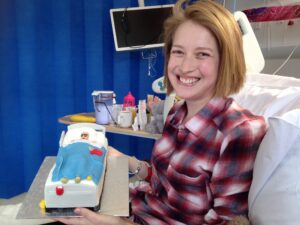
Billie McPartlan
In the summer of 2015, 28-year-old Billie McPartlan was building her career as a PA working at Canary Wharf in London. She had enjoyed a holiday to Ibiza with friends and was excitedly planning her wedding to Tony the following year.
But she began to notice how tired she was and that she had aching arms. Billie’s energy levels were low unless she kept eating, but despite this she was losing weight.
“The ache in my arms was very intense and worsened at night to the point I couldn’t sleep unless I took the painkillers I’d been prescribed for back pain,” said Billie, now 39, who lives in London.
“I went to the doctors and they couldn’t find any other reason than a bad strain. I mentioned I’d recently switched yoga teacher and they thought it might be that. I was given different painkillers and told to come back if the problem persisted.”
The medication didn’t work, and one day the pain was so bad Billie went to the local NHS walk-in centre.
“The nurse said that my heart rate was really high – it’s normally pretty high, so I wasn’t worried and didn’t realise it was worse than usual. She also said I looked really anaemic and that I needed an emergency appointment with my doctor. I managed to get one the following day and he gave me a blood test. I went back to work afterwards. It was our company bake sale and I turned up with all my cakes but had to hold on to the lockers to stand upright! A colleague sent me home. That night I woke up and my bed sheets were drenched with sweat. I was in the shower the next day when the GP rang me and said I had some abnormalities in my blood.”
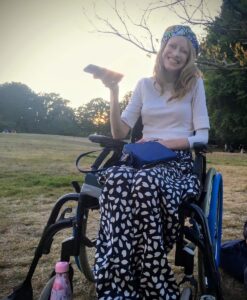 Billie was sent to A&E at the Princess Royal University Hospital in Bromley, Kent, and was admitted to a ward for a blood transfusion.
“They kept asking me if I’d taken drugs in Ibiza! I honestly hadn’t but I had to tell them over and over again. I thought maybe I’d caught something on the plane. I still didn’t realise how serious it was at that stage.
“The haematology doctor came and said he wanted to do a bone marrow biopsy. Then they moved me to another ward. Mum and Tony were with me by this time and they noticed it was the oncology ward although I didn’t spot it at the time.”
On 4th September 2014 Billie was told she had B-Cell acute lymphoblastic leukaemia (B-ALL). ALL is one of the most common childhood cancers, but almost unheard of in her age group. Only 70 cases per year are diagnosed in the UK in 25- to 39-year-olds. The pain in her arms was a common ALL symptom of bone pain.
“I initially cried out in shock but then became calm. I asked if there was treatment, and I was told there was. Then I said to my husband and mum ‘Well that’s what I have to do’. But I think I remained in shock for some weeks after that.”
Treatment began two days later after Billie was transferred to the Kings College Hospital in London which was running a new trial called UKALL 14.
“I had six weeks of inpatient chemotherapy, a month of daily outpatient chemotherapy and immunosuppressant treatment. Treatment was life changing, emotional, unsettling, exhausting, unknown, unpredictable, intimidating and often felt never ending. Every cycle became harder as I felt it eat away at my strength and my energy. I also really struggled with the steroids. They made me so twitchy and anxious and almost delirious. I kept thinking I’d dreamt the things the doctor had told me.
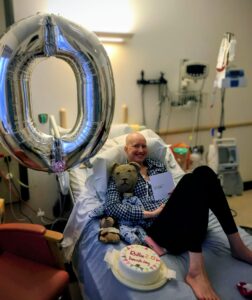
Billie during treatment
“They’d planned a stem cell transplant but that was delayed as I had a wound that wouldn’t heal and needed surgery to close it. Because of the delay I needed to have more chemotherapy. I then had five days of total body irradiation followed by some more chemo and then on 31st March 2015 I had my stem cell transplant from an anonymous German donor.
“Afterwards I felt severe weakness. Everyone put it down to the transplant but I felt it was something more. Three months later I had a fall in hospital. From that point on I gradually lost more and more strength. I couldn’t even roll over in bed, or do anything for myself, even eat. After what felt like endless tests I was diagnosed with chronic inflammatory demyelinating polyneuropathy (CIDP). My new cells had attacked my nervous system.”
CIDP is a rare autoimmune condition that affects the myelin sheath around peripheral nerves. It’s closely related to Guillain-Barré syndrome (GBS) with many doctors considering CIDP to be the long-term form of GBS.
“I spent over a year as an inpatient, with six months of this time in neuro-rehab. I had countless infections and lost most of the sight in one eye. The first seven months at Kings I cried every day. I had a psychiatrist and plenty of support but I was really depressed. Then they moved me to Frank Cooksey specialist neuro-rehab unit at Orpington Hospital. This was a different experience to a fast-paced and busy hospital. They were like a family there, I had the same nurses and physios every day, and this was where I learnt to walk and do things for myself .”
During her entire gruelling journey through treatment, Billie’s fiancé Tony had been by her side supporting her and looking after her. It was during this time that the couple were able to get married.
“We’d had to cancel our original wedding of course but the venue and everyone was incredibly kind and let us move the date. In fact a lot of my physio became about preparing me for the big day. The physios helped me learn to hold a glass and go to the loo while I had my wedding dress on! We finally got married on 25th March 2017.”
After the wedding, Billie returned home with physiotherapy support. After a few months she was doing well, even managing to go back to work. But towards the end
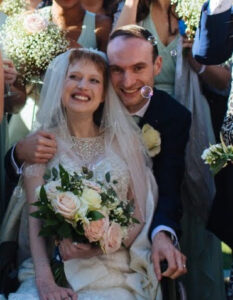
Billie at her wedding
of the summer there was a shock – Billie’s ALL came back.
“After my relapse they put me on immunotherapy but a few months in they found my donor cells were showing AML. So my own cells had ALL, and the donor’s had AML. I switched to chemotherapy that could target both. My consultants said they were willing to try a second transplant although I was very unwell and the chance of success was low - I think 10%. But I wanted to try anything and had my second transplant, after total body irradiation, in February 2018. The donor was again from Germany but had been too young to be on the register the first time round.”
Billie was very ill after her transplant although she says this time her emotional reaction was different.
“The first time I was so desperate to get back to how I was. But the second time I was much more accepting of everything that was happening to me and let my body do what it needed to do. Saying that, it was hard – I had lots of Graft vs Host Disease symptoms with my gut and skin.”
Billie was eventually allowed home but with frequent hospital appointments. In 2019 there was a further serious complication - it was discovered that she had kidney failure. She had four years of dialysis and then in 2024 husband Tony made the ultimate loving gesture – giving her his kidney for a transplant.
“It was such a shock to find out Tony was a match – it’s incredibly unlikely to be matched with a spouse. Due to my medical history, it took a further two years for me to be fully signed off as ready. The whole process was extremely exhausting, emotional and frustrating. On the day of the surgery, I was worried about Tony, but not for myself. For someone so anxious I was incredibly calm. As soon as I knew Tony’s operation went well and he was ok I just felt ready.”
Tony went home after a further two nights in hospital and Billie joined him the next day. Her mum looked after them whilst they recovered.
“It was very hard to see Tony in pain and discomfort, but at the same time we were overjoyed the kidney was working well and the freedom it could give us. Dialysis completely dictates your life, where you can go, what you can eat, how much you can drink.”
Billie is now keen to share her experiences to improve the journey of others and to give something back to the charities that had supported her and the hospital that is so close to her heart.
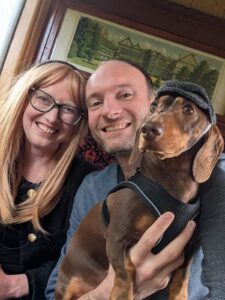
Billie with Tony and their dog
“I have been a Governor at Kings College Hospital for almost six years and am now completing my final term. I’ve been able to share my experiences at conferences, attend parliament and have volunteered and continue to volunteer for charity, including as Leukaemia UK Community Champion. I feel privileged to hold these roles, provident patient voice and champion such worthwhile causes.
“Leukaemia has changed my life for ever. I have been impacted massively both physically and psychologically. I don’t know if I’ll ever fully accept the new me. I now live with permanent disability, osteoporosis, chronic GvHD and am looked after by a number of specialist clinics.
“Leukaemia has also had a significant impact on my mum and husband who became my full-time carers overnight. Tony, who used to work in the private sector, gave up his job and now works for a charity. He wanted to do something more fulfilling. He also developed a passion for politics and became a local councillor, something he said he would have probably never considered before this happened.
“I have slowly tried to make changes to my life. I learnt to drive an adapted car to give me more independence, I found gym classes that were suitable for those with a disability - I used to love yoga, Pilates and swimming but I can’t swim or balance anymore.
“I have always been career-focused and taking five years off work was a huge set back for me. But my experiences have led me to do things I never thought I’d do. Not long after my diagnosis my husband and I set up a small charity, one of our first fundraisers was for Leukaemia UK as they had been involved in funding the first ward I had been treated on. We now provide support to people with cancer or long-term health conditions.
“But every day I worry about relapse. Every period of illness I jump to the worst-case scenario. I still don’t think I’ve fully accepted how this has changed my life, I don’t think I ever will. I just try to cope in the best way I can. Although it’s hard living in fear, life is more precious, every milestone feels more remarkable, celebrations are more joyful and special moments are more cherished.
“My mum and Tony have been a constant throughout my treatment. They have provided me with so much love, care and support. The nurses would always comment about how lucky I was to have them by my side. I don’t think I could have gone through it without them.
“Tony had to do things I would never have expected a partner to have to do for. I needed help with absolutely everything including going to the toilet. He and my mum spent almost a year taking turns sleeping on a recliner so they could care for me over night. Tony would have to get up and go to work the next day.
“This May we’ve been together 16 years. It’s hard to put into words what he means to me; he’s my superhero. Although I’ve been through so much I’m so lucky to have him by my side, it’s beyond what I ever could have imagined from a partner.”
Share your story
We want to help people tell and share the leukaemia stories that matter – stories like Billie’s and stories like yours.
Related posts
22 May 2023
Can the unique differences between stem cells tell us how well CML treatment will work?
What if we could predict how chronic myeloid leukaemia (CML) patients will respond to treatment? Could the unique signatures of CML stem cells hold the key to personalising treatment for…
17 April 2024
“Every little thing is gonna be alright” – three little birds tattoo marks mum’s recovery from one of the least survivable cancers
New research by Leukaemia UK which could reduce the side-effects of treatment for acute myeloid leukaemia (AML) welcomed by family affected by the disease. A family who was devastated when…
10 November 2021
An urgent call from One Cancer Voice group of cancer charities for the Comprehensive Spending Review to deliver Government commitments to improve cancer survival & care
Leukaemia UK has joined with 50 other cancer charities in writing to the Prime Minister, Chancellor of the Exchequer and Secretary of State for Health and Social Care. We are calling on the Government to urgently deliver on commitments to improve cancer survival and care in the forthcoming Spending Review.
6 March 2024
TV baker Juliet Sear announced as Leukaemia UK Ambassador
Leukaemia UK is excited to announce long-time supporter Juliet Sear as their latest celebrity Ambassador. Juliet, who has been an enthusiastic supporter of Leukaemia UK for several years now, wanted…