
27 Feb 2026
“I’m also lucky enough to have forged an incredible friendship with my donor Rachel”
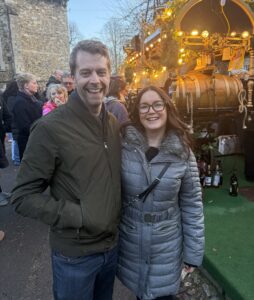
Ian meets with his donor Rachel
Meeting the woman who donated the stem cells which saved his life has had a profound impact on Ian Thomson. He’s now made it his mission to encourage people to sign up to donate, particularly those from Black, Asian and Minority Ethnic (BAME) and other diverse communities, where leukaemia patients often struggle to find donors.
In early 2019 Ian was living with his wife, former BBC reporter and wine entrepreneur Amanda, and two children. He was busy as a publicist for the film industry, and, at 49, was a regular cyclist and in excellent health. But throughout the spring he began to feel increasingly tired. Then one day Ian noticed he had a stiff neck and a lump under his arm. Swollen and painful tonsils quickly followed.
“I saw my local GP twice, but he didn’t take it seriously,” said Ian, now 54, who lives in Winchester. “The symptoms got worse and the advice was that if it didn’t subside to go to A&E. In the week of 3 June 2019 I’d deteriorated to the extent I couldn’t get out of bed. Amanda took me to A&E in the Royal Hampshire County Hospital in Winchester where I slumped in a chair in the waiting room.”
Ian was initially tested for a possible polyp on his tonsils. He was put on a hydration drip and given steroids and antibiotics, and doctors took blood tests. He felt immediately better and was allowed to go home.
“I got a call the next day from one of the consultants asking me to pop back in for another blood test. I felt so good at that point I had all my gear on and was just about to go out on my bike. They took another test and asked me to return within the hour. I had a coffee, made some work calls, and came back to reception to be immediately whisked into haematologist Dr Jenny Arnold’s office. She broke the news to me that I had leukaemia. I was stunned. I asked if I had more than a few days or weeks to live. She didn’t directly answer that question but told me to go home, pack a bag and go straight to Basingstoke hospital where a team would be waiting for me.
“I went home and walked into the kitchen and said to Amanda ‘apparently I’ve got leukaemia’. Of course she burst into tears but we both said we didn’t think it could be right, it seemed too much.”
When the couple arrived at Basingstoke Hospital Ian remembers around ten people waiting at reception and being taken straight to an isolation room. On Friday 7th June 2019 Ian was diagnosed with acute myeloid leukaemia (AML). He immediately started six months of intensive chemotherapy.
Ian and his wife Amanda
“They did actually allow me home for one night before it started. We took my daughter, who was 17 at the time, and son, who was 12, out for dinner. We told them I had to go to hospital as something was wrong with my blood. We didn’t mention cancer, and I told them it would be fine. That haunts me as I now think it was the wrong thing to do. We should have told them everything, however difficult it was. When things were at their worst, my son said to me ‘you said it was going to be alright and it’s not alright’. I know now I should have communicated with them more honestly, however much in shock I was and however well intentioned.
“Weeks later the consultant and registrar offered to talk to my children as they were struggling. My son asked them some very direct questions about whether his Dad was going to die and if they could fix me. They were very honest and that helped him.”
Tests revealed Ian had the FLT3-TKD with NPM1 mutation, giving him a slightly better prognosis. However, after the second cycle of chemotherapy doctors told him they were planning for a stem cell transplant as his chances of survival without one were slim.
“I was put on the FLAG-IDA four-drug chemotherapy regime with a big 11-day dose to start with which was brutal. I was also put on a trial for Midostaurin.
“One of the drugs sent me into a form of psychosis. It changed my personality to one of the henchmen in a Guy Ritchie film! I was literally shouting at everyone with a cockney accent, demanding things and issuing orders. I shouted at Amanda down the phone, and at one of our employees, as foolishly I was still trying to work from my hospital bed. They took me off that drug immediately and fortunately I returned to my normal self!
“Apart from that I had the expected hair and weight loss, vomiting, diarrhoea, fevers and lethargy. They gave me a lot of nausea-reducing medication but I still went down from 72kg to 55kg during my treatment.
“During my third cycle I got sepsis, was transferred to the High Dependency Unit and put on Noradrenalin for two or three days. A worrying ECG also sent me to a heart specialist who used a camera to check my arteries via my arm. They complimented me on ‘how clear my pipes were’, probably due to my fitness levels and lifestyle, so amidst everything else falling apart in my body and having sepsis and leukaemia I suppose that was something!”
After four cycles of chemotherapy, Ian was transferred to Southampton Hospital for his stem cell transplant. A donor – a woman in Scotland – was found for Ian through Anthony Nolan and the DMKS register, and on 12 February 2020 he received her donor cells following a fifth cycle of chemotherapy.
“The initial transplant was successful, but I then developed Graft Vs Host Disease (GvHD). My face and head swelled up, and my skin peeled from head to toe over a period of a few weeks. I was put on heavy doses of Cyclosporin throughout the rest of that year and attended two sessions a fortnight of blood ‘spinning’ where the team aimed to calm the T Cells. By the beginning of 2021 my GvHD had disappeared.
“I am so fortunate that I recovered quickly. I am fully back at work, I’m cycling again and doing everything I did before – possibly better. My grey hair fell out during chemo and was replaced post-transplant with beautiful brown hair! So, there is an upside.”
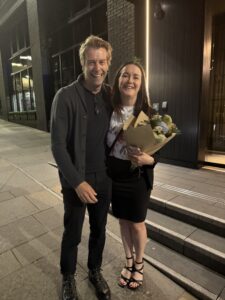
Ian meeting Rachel for the first time
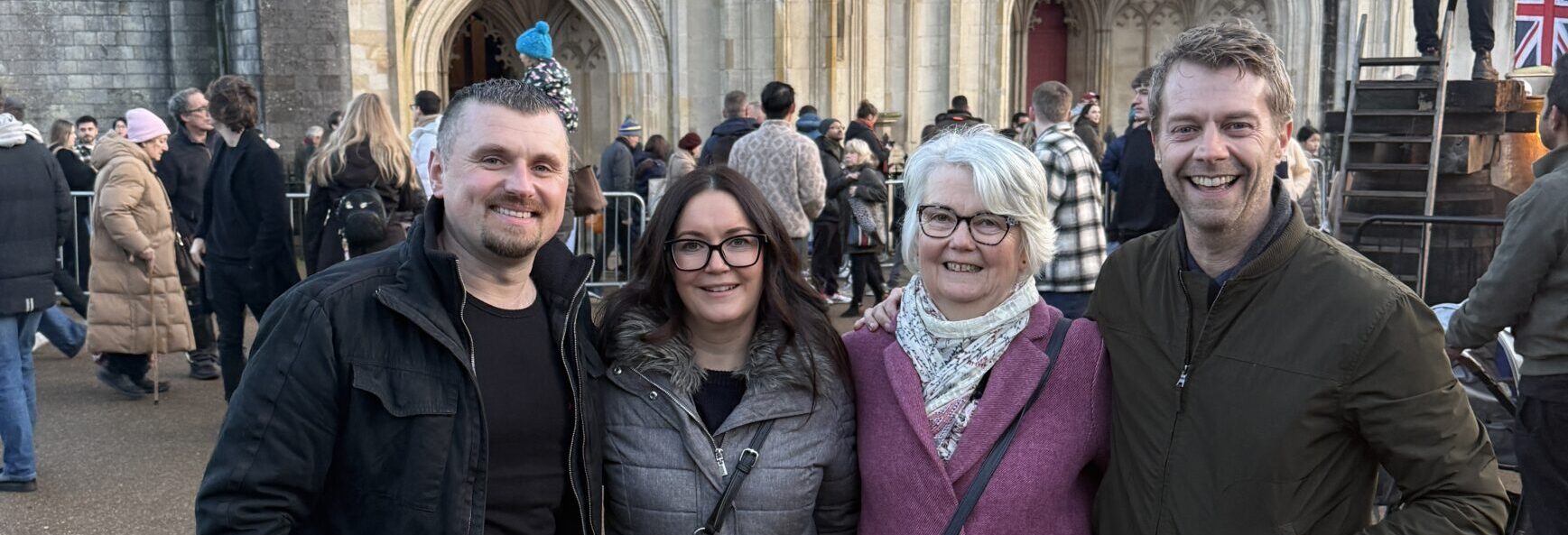
“I’m also lucky enough to have forged an incredible friendship with my donor Rachel. We wrote anonymously to each other after my transplant and on the very day the five-year threshold for personal contact arrived I contacted Anthony Nolan and asked for her details. She lives in Glasgow where a part of my family were based for centuries so I wonder if there is a genetic link. Our families have now spent time together and we hope to remain close friends and promote the importance of stem cell donation for many years to come.”
Ian’s donor Rachel, 44, who works as a nurse, said: “When I found out there was a match it was a bit surreal. They asked if I was still willing and I said ‘of course’. I don’t think it felt real until I went to Manchester for my check-up. The nursing staff were amazing, made me comfortable and talked me through the whole process. It was painless.
“It made me so happy to meet Ian and to see him living his life because I’d donated. I would strongly encourage others to sign up, particularly from Black, Asian and other diverse communities. Lives are being lost because there are not enough donors from their genetic pools.”
Despite Ian’s physical recovery, the emotional scars run deep, and he remains determined to highlight the impact that leukaemia diagnosis and treatment can have on the whole family.
“They arranged therapy for me but I kept saying I was fine. Then one of the nurses gave me a talking to and said I had to be more honest as it was a waste of time. That next session with the therapist I found I was absolutely distraught and in floods of tears. It was then I recognised I had PTSD and it was going to be a long journey.
“My children had the security of a solid family unit for so many years and suddenly I’m not there. Amanda was juggling looking after me, running a business and being strong for two children. You can’t understate the trauma.
“But we’re all moving forward and I’m now dedicated to encouraging more people to sign up as stem cell donors, particularly people from diverse backgrounds. I was very lucky to find a 10/10 match. I am white British. But many others who have mixed parentage are not. Amanda is half Pakistani and half English, so my son and daughter are mixed heritage. In fact we knew a young person who had AML and died because they couldn’t find a stem cell match for her ethnicity. This has to change.”
Share your story
We want to help people tell and share the leukaemia stories that matter – stories like Ian’s and stories like yours.
Related posts
11 February 2026
The National Cancer Plan: what does it mean for people with leukaemia?
The Government’s new National Cancer Plan for England, which launched on World Cancer Day 2026, marks the most significant progress in policy for leukaemia and other blood cancers in more…
25 June 2019
Championing groundbreaking therapies and emotional support
We are proud to be at the forefront of funding innovative research into gene therapy treatments
6 February 2012
Blood cancer: Top tips for keeping mentally healthy
Keeping mentally healthy when you have a blood cancer can be challenging, but there are lots of things you can do to help keep yourself psychologically well. Here, the Leukaemia UK Mind & Body team share top tips they offer to the patients they support
21 September 2022
A record year for Leukaemia UK London Marathon runners
62 runners put their best feet forward for Leukaemia UK A record 62 runners are taking part in this year’s London marathon to help fund vital research into leukaemia diagnosis,…